I wrote a while back that it’s not enough to debunk Kelly myths once and expect that true believers will straight away toss out whatever belief of theirs that had just been shown to be false, and move on. The natural response, initially at least, is to defend one’s beliefs, but rational people will eventually be persuaded by the force of the logic and the facts to move on. However, for reasons psychologists might know, some people will never let go, no matter how irrational their belief is or how strong the disproving evidence is. These are the kind of people who still insist that the science is wrong and the earth is flat! These are also the kind of people who cling to all the mythology about Ned Kelly : much of it has been been debunked but they remain in angry and mostly uninformed denial, as they do on the Best Bloody Man page, pre-occupying themselves with Kelly trivia, and as is seen on Peterson and Rowsells pages, with all kinds of conspiracy theories and spurious justifications for continuing to claim otherwise. Most of the people on those pages will never change – theyre trapped in a Kelly cult delusional system that blinds them to objective reality, to reason and logic and facts. But there are no doubt plenty of other people with open minds who still think Jones Kelly Republic was a viable thing…all those people lack is information…so read on !
The reality with myths is they have a kind of cultural momentum that resists change, and change requires exposures of the myth to be continual.
The greatest of the Kelly myths is probably the claim that the Kelly outbreak was a political movement , and its goal was to declare the North East a Republic after a bloody confrontation at Glenrowan. Ian Jones was the Kelly enthusiast who developed and popularised this claim, and it more or less achieved its objective of rehabilitating Ned Kellys image from notorious violent criminal to brave revolutionary hero, akin to Peter Lalor of Eureka fame. However, not everyone was convinced, and in the last decade the myth has crumbled, a reality that is nowhere more apparent than in Glenrowan itself, at the new $5M Kelly Discovery Hub where the once central claim of Kelly historians no longer gets even a mention in passing : a truly huge shift in focus that signifies local rejection of the Republic myth that was centred on their town. Rejection of the myth is spreading….but it’s time to explain it all again, and add to the momentum.
To start with, it will suprise many to realise that Ned Kelly himself never mentioned a political ambition involving a republic or anything like it, not once, not ever – and he was a person who was never lost for words. In fact, he seemed very much in possession of the Irish ‘gift of the gab’ and was well known for his lecturing haranguing and hectoring of the hostages that he seized at Euroa, Jerilderie and Glenrowan, talking at length about himself and his ideas. But he never once enunciated any kind of coherent political strategy or vision, or even any political yearnings or insights, but rather voiced grievance and resentments, he spoke of vengeance and railed against police and authority in general. That kind of dialogue continued in written form in the Jerilderie letter, in which no political utterances were ever discerned until almost a century after it was written, people went looking for support for the theory of a Republic. All of a sudden they ‘discovered’ new meanings and found ‘political’ statements by Kelly that had never been noticed before. But really, they were no more expressions of a commitment to a political journey of reform than angry letters to the Editor of the local newspaper are. A political manifesto is a whole lot more than a few wild historical references, sweeping denunciations and unhinged threats.
But it wasn’t just Ned Kelly who never spoke of a Republic or anything like it – not one member of his family and not one of his supporters ever mentioned such a thing. Kelly apologists explain this with a conspiracy theory: they say it would have been treason to talk about it, so they kept quiet – but this is provable nonsense. For one thing, all kinds of alternative political theories and ideologies, including Republican were promoted and discussed openly in Victoria, and talk never resulted in people being hanged for treason! Even the Eureka insurrectionists, despite the killing, were all acquitted! And for another, the idea that every single one of the many hundreds of people who were supposedly in on the secret maintained an absolutely unbroken silence for the many decades that followed, and took this hermetically sealed secret to their graves without once letting anything slip is beyond impossible. Leaks would have been inevitable…and especially once the Outbreak was over, and as the years went by when a belief in the need for secrecy had passed people would certainly have broken their silence. But no such thing happened. It wasnt that they kept a secret – there was no secret to be kept.
In 1911, a decade after satirists had published mock Kelly history suggesting he was planning to become President, Kellys mother gave a famous long interview to a journalist called Brian Cookson. The outbreak had ended 30 years earlier, and it was long past the time when even the most paranoid would have felt a need to maintain the secret – the idea was already out there – but she gave not the slightest hint of her son ever having even the most minor political ambition.
By this time many books about the Outbreak had been published, such as C H Chomleys classic ‘The True Story of the Kelly Gang of Bushrangers’. Several had been published while Kelly was still alive, and author of one of them, ‘Outlaws of the Wombat Ranges’, G W Hall claimed insider knowledge – but not one of these writers ever mentioned hearing anything from anyone about a political campaign, a Republic or anything like it.
In 1929, Ellen and Jim Kellys friend and neighbour Jerome J Kenneally published another classic work “The Complete Inner History of the Kelly Gang and her pursuers”. Kenneally, an educated Unionist and Journalist who could easily have been sympathetic to political ambition, listed Neds cousin, so called Fifth Gang member Thomas Peter Lloyd as his principal informant. He produced a book that was extravagantly supportive of the Kellys, portraying them as victims. It includes a glowing endorsement from Ned Kellys brother Jim who said Australia was now ‘in full possession of the truth’, but the book, purporting to be the ‘complete’ history included absolutely nothing about a Kelly republic or a local uprising or anything like it. Not one word!
One can only wonder how anyone ever had the idea that the Outbreak was a political uprising when Ned Kelly himself and nobody in the Kelly family, and nobody related or associated with them for 50 years after it was over ever even hinted that it was. And yet that was exactly what happened : how come?
In 1948, Max Brown published another of the Kelly classics, “Australian Son”. Brown made a big deal of how thoroughly he did his research, treading the highways and the byways of the north-east and listening to the stories and gathering information from now elderly living witnesses to the outbreak. None of them talked about a Republic. Brown included the entire Jerilderie letter as an appendix to the book, but didnt identify any particular republican or political sentiment in it. However, in his Foreword he claimed that in 1880 there was a rumour that a Republic declaration had been taken from Kellys pocket when he was captured, but Brown got it wrong. The reference from 1880 was a rumour that ‘a pocketbook containing letters’ were taken from Kelly when he was captured – not a Republic declaration. However, Browns false claim was out there, in a work that was hailed as a classic, and in the way that rumours and inaccurate references do, this one was eventually asserted as fact – Kelly had a Republic Declaration in his pocket at Glenrowan! But thats not true.
A few years later a journalist by the name of Leo Radic suddenly seemed to recall that he had seen this Declaration at the London Public Records Office and several people rushed off to London to find it…and returned empty handed. Forty years later Radic changed his mind: he hadn’t seen it after all!
In 1954 Frank Clunes book, “The Kelly Hunters” appeared : again no reference was made to a republic or to Kelly having any political aspirations.
Meanwhile, the satirical reference from 1900 to Kelly becoming president was being shared around the newspaper circuit, modified and expanded with each re-telling, and accorded increasingly but entirely illegitimate status as an actual rumour from 1880. Oviously the idea was starting to circulate.
All that needed to be done to legitimise the myth was for someone to bring these two rumours together: a republic document taken from Kelly when he was captured, and the story about a plan for him to become president. Enter Ian Jones, an already committed Kelly admirer who was troubled by Kellys plan for Glenrowan, a plan to commit what Jones called ‘a criminal atrocity of monstrous proportion’, a plan that was at odds with the view Jones wanted to promote of Ned Kelly as an admirable figure driven to the edge by the harassment and persecution of police. He wanted to find a reason to explain the planned atrocity away.
Jones asked the son of the so-called fifth Gang member Thomas Peter Lloyd – whose name was Thomas Patrick Lloyd – about these stories and was told they were true. Thomas Patrick Lloyd told Jones he had learned all this from his father and as a boy had seen exercise books containing the minutes of meetings that Kelly and his republican co-conspirators were holding in secret. He also gave Jones details about the two rockets that Cst Arthur reported seeing, telling Jones who fired them and why.
Sensationally, many years later Lloyd admitted to Doug Morrissey that much of what he told Ian Jones was made up: Gang descendants like him had become fed up with journalists who seemed to ignore descendants accounts and print whatever they liked – so Tom decided to tell Jones what he thought he wanted to hear, fake history that he made up to keep him happy. Jones should have realised this was all fake history because Tom Lloyds father was J J Kenneallys principal informant and he clearly had never heard any of this stuff because he never said one word about it to Kenneally. If he had heard of it, it would have been in Kenneallys book, which, you will remember was endorsed by Jim Kelly as being the full story!
Never-the-less, in 1967 at a Symposium in Wangaratta, long before Lloyds confession to Morrissey, Jones pulled all this together and presented Australia with what he called his “New View” of Ned Kelly. The “New View” can be read in the published proceedings of the symposium ‘Ned Kelly Man and Myth’: according to Jones Kelly wasn’t a violent criminal but the leader of a selector backed political uprising that planned to declare the North East a Republic, after his gang and a sympathiser army had defeated the police in a confrontation at Glenrowan. Once the train had been derailed and survivors killed or taken prisoner by the Kelly gang in their protective armour, the sympathiser army was going to be called into battle with signal rockets…eventually, a prisoner swap was going to see his mother released from prison, banks would be raided and somehow the region would be declared a Republic. It wasn’t criminality but a just war! Just ignore the fact that Ned Kelly himself doesn’t seem to have heard about it!
One really cant help but admire Jones, an amateur historian, for the brilliant way he promoted his idea, and how quickly he was able to convince almost everyone that his ‘new view’ should be accepted as genuinely historical. Doubters were quietened by the force of Jones debating style, his extensive knowledge, his quick wit and his persuasive personality, not to mention his influential TV miniseries from 1980, The Last Outlaw that skilfully presented his personal view of the Kelly story as objective history. The Kelly narrative switched to being about a genuine Australian hero and an icon, and stayed that way for nearly 50 years. An entire tourism industry sprang up to accommodate the rising interest in the new Australian legend.
Inevitably though, cracks started to appear, notably with the publication of Ian MacFarlane ‘The Kelly Gang Unmasked’ in 2012 when the historical basis for the entire modernised narrative of Kelly as hero was subjected to withering academic review. The death knell for the Republic was the 2018 publication of ‘Ned Kelly and the Myth of the Republic of North Eastern Victoria’ by Melbourne historian Dr Stuart Dawson who examined in meticulous detail every component of the Republic narrative from the claims about local unrest, a sympathiser army and the Rocket signals to the story of Leo Radics report that he had seen a Declaration. It is unarguably the most important piece of modern research into the Kelly story and is required reading for anyone interested in the history of the Kelly Gang. It covers everything I’ve mentioned in this Post and more and in much greater detail, is supported and backed up by literally hundreds of references and is no doubt the reason why at the Discovery Hub in Glenrowan itself, Jones theory about a Kelly Republic of North East Victoria isnt mentioned even once. That is a remarkable turnaround, given that when the Hub was being planned, the Republic narrative was mainstream: its now been consigned to the wastebin of history.
Download Dawsons brilliant research and read it for free by following the link top right of this page.
Hi David, it’s hard to believe it was eight long years ago since I put the Kelly Republic Myth book up as a freebie, yet there are still drones and drongos in denial of the myth’s demolition. “No, Dawson got it wrong! Jones is an ‘expert’! How dare anyone dis Jones!” Well, ha, ha, ha 🤪
Another sucker for the republic leg-pull was Canberra university professor John Molony. Molony also went bush and interviewed Tom Patrick Lloyd, an ex-police officer BTW, and Tom fed him with more cock and bull about a Kelly republic and a sympathiser army, which Molony dutifully regurgitated in his book “I am Ned Kelly”. The funny thing is that he told Molony some things that were actually the opposite of what he’d told Jones! I spell this out in my book. Talk about taken for a ride!
Anyway, Morrissey was not the only one that Tom fessed up to. Leo Kennedy as a young lad was with his dad who was chatting with Tom. Tom said similarly to what he told Morrissey, that he was sick of the Kelly nuts writing all sorts of rubbish about the outbreak so he decided to pull their legs; and that it had maybe backfired because so many people believed them!!
Anyone interested can read about those retractions and admissions in Doug Morrissey and Leo Kennedy’s books.
It is true that the Kelly Hub dispensed with any thoughts of giving the Kelly republic myth any wall space. The idea was so mind bogglingly stupid in the first place that I initially thought that Jones was doing a deliberate leg pull. But it was his leg that was pulled, even harder than the good Professor Molony’s. Universities often make people stupid, especially in the humanities. Look up “post-processual archaeology” if you don’t believe me. Or just look at the woke lunatics graduating over the last 20 years. None of them can put a plain English sentence together but all
If them can speak for hours in words of 5 or 6 syllables. They make no sense at all but they think they’re philosophers.
Probably the most important part of my book is the short section that shows how a little spoof article in the Bulletin in 1900 about Kelly going to declare himself President of a Republic, was picked up by a 1940s “Believe it or not” storyteller and given a new lease of life in news snippets and on radio. That’s how the BS tale became a rumour. The rumour that Brown and Jones and Sidney Nolan heard, which was always intended as a joke but they got sucked in and took it seriously. Dumb dumbs.
I’m not really sure who we should blame for this fiasco…would it have even happened if Thomas Patrick Lloyd hadn’t lost his cool and fed poor desperate Kelly fan Ian Jones with all those lies?
Yes, Ian Jones, as an author of history had a duty to check his sources and subject lloyds claims to proper scrutiny….so he has to be held accountable but I wonder if Lloyd ought not to be more publically held to account?
You may not know but his now elderly daughter is a prominent contributor to the Best Bloody Man Facebook page, still lives in the north-east and unsurprisingly, defends her father and is a hard-core Kelly Republic believer. Her posts indicate she is not actually all that familiar with the detail…..
Quite randomly, a few years ago she approached me at the SLV when I was looking at the Kelly Armour, and said to me “He wasnt all that bad, you know” and I looked at her and said “Oh yes he was…” and she walked away. Neither of us knew who the other was at the time…Small world hey?
Hi David, I don’t have Facebook and even if I did I wouldn’t be going to waste time on Kelly nut ramblings 😂. Thanks for the tip off though. Is there anyone in Victoria who isn’t somehow related to someone whose great grandmother’s cousin’s half brother rode with Ned or had him help fix a shed or round up sheep or dig for gold etc.?
I remember there was someone years ago who swore they knew someone other than Radic who claimed to have seen a real written or printed declaration of a republic of Victoria (or northeastern Victoria, Jones said both at different times), and was keeping it a big dark secret? It would be fun to trace that rumour and see exactly what that claim was, but I’m busy feeding the cat so someone else can look
Into it 😂😂😂
Hi David, I just found this live action photo of a Kelly nut still believing in Jones’ ridiculous Kelly Republic theory 8 years after it was dropped into the quicksand of stupid ideas. This guy thinks he knows the location of a printed copy of the “Declaration of a Kelly Republic of North Eastern Victoria”, just up the road from Lasseter’s Reef. I suspect that a few slabs of Victoria Bitter underpin these recollections.
Attachment
“No political utterances were ever discerned [in the Jerilderie letter] until almost a century after it was written”. To be fair, most people weren’t able to discern much at all as the letter wasn’t widely accessible for several decades. The general public only had summaries and some excerpts to go by. Even so, the earliest published summary, from The Australasian, notes the letter’s political dimension:
“The narrative dwells strongly upon the wrongs Irishmen are suffering from the British Government, and it appears as if Kelly had some idea of making national and not private grievances the excuse for his outrages.”
What is the date of that comment from the Australasian?
Its a curious remark.
I believe its wrong about where the emphasis lies in the letter : I think most people would agree it very strongly dwells on PERSONAL grievance, and reference to ‘national’ grievance is minimal.
Hello, the source on that quote is “Interview with Messrs. Tarleton and Living”, The Australasian, 15 Feb 1879, p. 19. There was also William Elliott, the Jerilderie schoolmaster who wrote of the letter:
“Kelly was undoubtedly ambitious, and would seemingly have liked to have been at the head of a hundred followers or so to upset the existing government or bring them to terms.”
I don’t think the issue is whether personal grievance dominates. It clearly does. But Kelly effectively makes the personal political. Through his own narrative, he denounces colonial police and British legal structures as oppressive, criticises land monopoly and class inequality, frames his bushranging as justified resistance to systemic injustice, and threatens escalating violence as a response to continued oppression, positioning himself as more than a criminal. This culminates in Glenrowan, which, in light of the letter, can reasonably be interpreted as a politically motivated insurgency. Derailing trains and blowing up courthouses and police barracks is not typical bushranger behaviour.
Sorry I think I forgot to sign my name with the latest reply.
Jerilderie schoolteacher William Elliott, who provided the synopsis of the Jerilderie letter that was wired to the Argus, also wrote that while much had then been said of the letter’s length, “it would not have occupied more than two columns space in long primer [standard type] in a newspaper”, and he thought “the greater portion … little better than emanations of wild fancies from a disordered brain”, Jerilderie Herald and Urana Advertiser, 2 January 1914, p. 1.
So whatever Kelly may have seemed to have thought about gathering some followers, Elliott wasn’t having a bar of it.
Given the letter’s general roughness and poor grammar, it’s not surprising Elliott the schoolmaster considered it the product of a disordered brain. But a letter can be technically bad on those grounds and still have clear lines of argument. In Kelly’s case, he repeatedly generalises his own experiences into a broader structural critique. In other words, and to return to crux of the issue, he goes beyond private grievance and into the kind of framing that at least some of his contemporaries saw as “national” rather than purely personal.
I must reject Phil’s suggestion that some of Kelly’s contemporaries saw the Jerilderie letter as having a political dimension or a ‘national’ rather than purely personal framing. There are two sources given as lending support to that idea. The first is claimed by Phil to be “the earliest published summary, from The Australasian”, but the “earliness” is meaningless. The same summary was sent by a wire service all over the place that week and appeared in many syndicated newspapers, for example the Maitland Mercury, https://trove.nla.gov.au/newspaper/article/18917902
A much fuller summary of the letter was printed in the Age the same week, on 18 February, taken from an interview with NSW publican Mr Hanlan who had made a handwritten copy of the original and spoke to the reporter from memory. Neither Hanlan not the Age gave any sense of Kelly having had any political notions in the published synopsis and comments which are here, https://trove.nla.gov.au/newspaper/article/199362803
As to Phil’s claim that “the earliest published summary, from The Australasian, notes the letter’s political dimension”, this rests on one sentence added to the wire service summary that does not appear in any other copy of the summary: it is from whoever edited the Australasian’s article.
First, the Australasian, Saturday 15 February 1879 p 19, says the paper has “received a copy of the written statement which the outlawed murderer, Edward Kelly, left at Jerilderie on the occasion of his last robbery under arms.” This is not correct: no newspaper was given access to the letter on the instructions of the police to Living, as the Age article made clear.
Second, the Australasian’s summary ends with “An account is given of the terrible tragedy at Mansfield, but it is obviously a string of falsehoods, and it would be improper for any journal to publish it. It is admitted that the police were not in any way the aggressors, but were surprised and shot down in cold blood. The narrative dwells strongly upon the wrongs Irishmen are suffering from the British Government, and it appears as if Kelly had some idea of making national and not private grievances the excuse for his outrages.”
Phil suggests that here Kelly “goes beyond private grievance and into the kind of framing that at least some of his contemporaries saw as “national” rather than purely personal.” Yet far from elevating Kelly into a political rebel, the paper notes that Kelly’s letter is making excuses for his murderous choices by blaming everyone and everything but himself. There is nothing in that article to support that idea that any of Kelly’s contemporaries saw any type of “political rebel” framing in Kelly’s rant. Indeed, that same article describes the Jerilderie letter as “a wandering narrative, full of insinuations and statements against the police, and of the type familiar to all who have had experience of the tales which men of the criminal stamp are accustomed to tell, it being as impossible to prevent these men from lying as it is from stealing.”
Now that we have the original Jerilderie letter available, it is abundantly clear that there is not a political bone in it. The easiest way to see that is to read the Cameron letter where absolutely nothing political appears and the famous Jerilderie rants about the English and Irish don’t exist.
Phil’s other source is William Elliott, the Jerilderie schoolmaster who wrote of the letter, “Kelly was undoubtedly ambitious, and would seemingly have liked to have been at the head of a hundred followers or so to upset the existing government or bring them to terms.” The source is the Jerilderie Herald and Urana Advertiser, Friday 2 January 1914 p 1, https://trove.nla.gov.au/newspaper/article/134454902#
From this, Phil claims that “Kelly effectively makes the personal political. Through his own narrative, he denounces colonial police and British legal structures as oppressive, criticises land monopoly and class inequality, frames his bushranging as justified resistance to systemic injustice, and threatens escalating violence as a response to continued oppression, positioning himself as more than a criminal. This culminates in Glenrowan, which, in light of the letter, can reasonably be interpreted as a politically motivated insurgency. Derailing trains and blowing up courthouses and police barracks is not typical bushranger behaviour.”
There are a couple of things going on here to note. First, the notion that the personal is political came from 1960’s feminism and has nothing to do with external political struggle, https://en.wikipedia.org/wiki/The_personal_is_political
Second, the notion that Kelly furnishes any kind of meaningful narrative either in the letter or any of his numerous ranting speeches to captives in his various hold ups and robberies is clearly wrong, as can be seen in what the captives themselves said about his rants in their interviews in the papers of the day.
Third, the claim that Kelly “frames his bushranging as justified resistance to systemic injustice” reflects some kind of Marxist interpretation of history which is frankly ludicrous. Kelly the career horse thief and criminal can paint whatever picture he likes, but it is at best a grotesque fantasy with no basis in reality. Kelly said not one rebellious political word, even during the siege at Glenrowan while he and the other equally non-political gang members were stuck in the Inn for a day and a night with their captives; even when captured at Glenrowan; even when given free access to reporters on the scene; even in his condemned cell letters. That is what demolishes the suggestion that Glenrowan could “be interpreted as a politically motivated insurgency”. There was not a political bone in his body.
Fourth, the claim has been built on an extract from schoolteacher Elliott’s 1914 serialised account of the Jerilderie raid, and the sentence “Kelly was undoubtedly ambitious, and would seemingly have liked to have been at the head of a hundred followers or so to upset the existing government or bring them to terms.” This is a classic misrepresentation of someone’s view out of context to try and argue a non-viable case.
In that same passage Elliott wrote, “The contents of the manuscript in question principally consisted of a long tirade against the ineptitude and untruthfulness of the Victorian police, who were designated “loafers, scoundrels and black-guards” of the deepest dye. The Victorian Government also came in for its share of vituperation and abuse for employing such men. Kelly called upon all and sundry to be up and resist, and hound down the scoundrels and wipe them off the face of the earth, and so on. Kelly was undoubtedly ambitious, and would seemingly have liked to have been at the head of a hundred followers or so to upset the existing government or bring them to terms. With his ambition there must also have been a lot of the Don Quixote about him. … To judge by reading between the lines of the manuscript which he was so anxious to have published, one would be inclined to think that the leader of the outlaws was also a bit of a lunatic, or rather, a dreamer, in his own way. One might also conclude that he was a desperate man, driven to desperation by his imaginary wrongs, and was then up in arms against the community, with his back to the wall.”
Phil’s argument is a good example of modern academic theorising – cherry picking sentences to fit into an argumentative or analytic structure that has no regard for context or facts. It is what results from “theorising” a topic; subjecting it to some variety of Marxist critique and conclusion while slotting in assorted quotes out of context disguised as “proof” and hoping no-one notices. I have attached the Elliott article as a PDF so you can see how misleading that whole argument is. Kelly was a criminal dolt, not a political rebel.
Attachment Jerilderie-Herald-and-Urana-Advertiser-1914-01-02-Friday-2-January-1914-p-1-Elliott-on-Kellys-letter.pdf
Stuart, when you say that “there is not a political bone” in the Jerilderie letter, and support that by pointing to the Cameron letter, it sounds like you’re arguing that because the Cameron letter contains no political content, the Jerilderie Letter therefore cannot contain political content. I struggle to see how that follows logically. They are two different texts written in different contexts and for different purposes. The Jerilderie Letter has to be assessed on its own content, even if the Cameron Letter served as its template.
On Glenrowan, my point wasn’t that it was definitively a politically motivated insurgency. Rather, it is that it strongly resembles one in form and scale, and when read alongside the Jerilderie Letter, it becomes at least reasonably interpretable as something approaching insurgent rather than purely criminal violence. This is about how it can be read and framed, not a claim about explicit political intent.
I also think part of the disagreement comes down to how we’re defining “political”. If by political we mean a coherent ideology, then I agree the Jerilderie Letter doesn’t fit that description. But if we mean broader claims about authority, law, policing, class, and imperial power, then the letter clearly does contain political material. On that basis, it is too strong to say there is “not a political bone in it”.
Hi Phil, there is a much better explanation for Glenrowan and it is reflected throughout Kelly’s life. Kelly was a charismatic psychopath, as in a clinically diagnosed psychopath. The paper is attached below.
I am nowhere arguing that because the Cameron letter contains no political content, the Jerilderie Letter therefore cannot contain political content. I am stating that neither contains any political content as typically understood. Certainly it contains unhinged rants against the police, who were widely respected in the community of the day. There are many records of settlers writing to request a police presence in their towns, and this often meant a one-man police station. See R. Haldane, The People’s Force 1995: 58.
I don’t agree that the Cameron and Jerilderie letters were written written in different contexts and for different purposes. They were about 3 weeks apart with the same content as you can see from the illustration in the back of my Republic Myth book, and for the same purpose, for Kelly to blame everyone else for his troubles. The JL has more ranting; the texts otherwise overlap. There is also the third letter discussed in my book, which is less ranting but otherwise more of the same.
Glenrowan was not an insurgency. It was Kelly’s second attempt to blow up a railroad in revenge for his dear old mum being gaoled after aiding and abetting the shooting of Fitzpatrick. Play stupid games, win stupid prizes. He threatened it at the end of the Cameron letter with no political implications anywhere.
But what definitively scuttles the insurgency or rebel argument is his silence on any such notions when speaking to his various captives on numerous occasions at Euroa, Jerilderie and Glenrowan; and the the press after Glenrowan; and in his condemned cell letters. There was no Cause of Kelly. It’s a fantasy. Jones created it and breathed life into it for a couple of decades but it’s gone to dust now.
We can clearly trace how he constructed the myth, where it came from, how it grew from a 1900 spoof joke to a popular 1940s Believe it of Not tale, to something hundreds of suckers wanted to believe. His many acolytes are muttering quietly with embarrasment (or anger) as the narrative collapses back to its original bed of historical facts. Ian MacFarlane put it to bed in 2012 and I tucked it in and turned the lights out. Even the rabid unionist and socialist J.J. Kenneally saw nothing political in the Kelly saga regardless that he first wrote big claims about police persecution of the Kellys with “loaded dice”. It’s nonsense.
Attachment Scott-MacFarlane-2014-Ned-Kelly-Psychopath.pdf
Your point about the contexts being the same overlooks an escalation between the letters: the indefinite detention of sympathisers. Whatever we think of Ned’s motives, that represents a shift from a personal dispute to a broader conflict involving the state and his wider support network.
It’s true that Ned is already threatening to derail a train in the Cameron letter, so the idea predates these arrests. But according to Superintendent Hare’s spies, the first near-attempt was in direct response to the arrests. That doesn’t in itself make the act “political”, but it does complicate the idea that everything here reduces simply to personal revenge over the treatment of “his dear old mum”. The arrests, and the suppression of the Cameron letter, change the context in which the Jerilderie letter was written, and I think help explain the shift in tone and scope.
Also I think your reduction of Glenrowan to another train derailment attempt flattens the scale of what was being planned. Based on hostage testimony, Ned’s own words after capture, and police accounts such as Hare’s, the reconstruction we have suggests a coordinated attack against institutions of colonial authority, including the police headquarters and courthouse in Benalla. That doesn’t settle questions of intent, but it does indicate that the scope of the plan was not limited to an isolated act of revenge against individual officers. At the level of targets, it moves outside of bushranging as typically understood (criminal opportunism) and towards symbols of state authority. It makes a purely personal framing harder to sustain.
Expanding on the symbolic dimension, it’s unlikely coincidental that Kelly wore a green sash under his armour. Likewise, Joe Byrne setting a Kelly gang ballad to the tune of “The Wearing of the Green”, about the 1798 rebellion against the British Crown, suggests an engagement with a broader sense of resistance. This does not lend any support to the Jones republic myth, but it does indicate that the gang operated within a cultural-symbolic world where political meanings were already embedded, even if not expressed through formal political doctrine.
The posthumous clinical diagnosis is a worthwhile angle, but I think too reductive as an explanation for whole Kelly saga. It still only describes aspects of Ned’s personality and not the historical context in which events unfolded, which is complex and multi layered. These can’t be reduced to a psychological label, which in this case is being used rhetorically as a settled clinical fact when it is actually a retrospective interpretation.
Another point I forgot to mention: the psychopathy test is not being used “rhetorically as a settled clinical fact when it is a retrospective interpretation”. Clearly you did not read the paper I uploaded, or did not understand it. The psychopathy test is a currently valid clinical test and was in this case run by a forensic psychiatrist against well established criteria and does not need the subject to be present. It is an objective measure against set of specific criteria. It is not an “interpretation”. Nice try though…
Hi Phil, once again the evidence totally fails to support the argument you are trying to make. In the wake of the Euroa bank robbery on 14 December, warrants for the arrest of around 30 sympathisers were sworn out on 2 January 1879 and the arrests and detainments began. But there was no “escalation between the [Cameron and Jerilderie] letters” about this. The sympathiser arrests and detentions are unmentioned in the Jerilderie letter which Kelly sought to have printed on 8 February nearly a month later. There was no broadening about this of any sort in anything Kelly said either in the Jerilderie letter or to any of his captives at Jerilderie or at any later point.
A synopsis of the Cameron letter, read by journalists, was printed in the Herald 18 December 1878 which did not notice or mention any political statements or implications. The synopsis in a popular newspaper hardly counts as the letter’s “suppression”. The only change in tone from it to the Jerilderie letter is the extension of various passages into emotional rants; there is no additional information in the JL, just more whinging grievance. My own opinion is that it was expanded from a copy of the Cameron letter in stages while Ned and Joe were intoxicated.
Kelly’s vaguely expressed plans to rob a Benalla bank and blow up the police camp (= police station) are hardly symbolic attacks on colonial authority, as no such aim was ever voiced before Ian Jones concocted his political Kelly theory, but simply another idea to loot more funds and to disrupt the police pursuit.
The green sash has been dealt with elsewhere on this blog by multiple contributors. First, he wore a red sash at Stringybark Creek. Second, he was not given the green sash until after when the gang was already outlawed and on the run, as Kenneally wrote in the 3rd edition of his Inner History of the Kelly Gang; and third, he wore it as padding under his armour. There’s no other significance and he didn’t miss it when it was taken after his capture. It was just convenient padding; that’s all.
Byrne wrote a number of Kelly songs to various popular tunes and it’s not surprising that he knew the Wearing of the Green, being of Irish descent. Despite that song’s overtly political comments, ‘The Ballad of the Kelly Gang’ has no political content but is just a musical ego trip. Political meanings are not embedded into cultures; they are derived by theorists with a healthy dose of cultural Marxism. You can see this most easily in 1970s and 1980s feminism where these claims flowered like weeds.
The historical context in which events unfold are indeed complex and multi layered, but facts are facts. Any alleged narrative (such as Jones’ republican Kelly narrative) must necessarily rest firmly on facts. All narratives are story telling. If we are going to tell historical stories, the evidentiary base for the claims must be there. As I showed in analysing the Kelly republic myth, the claim was built on a dog’s breakfast of selective partial facts and hare-brained hypothesising.
The notion that “Based on hostage testimony, Ned’s own words after capture, and police accounts such as Hare’s, the reconstruction we have suggests a coordinated attack against institutions of colonial authority” flies in the face of the facts that there is nowhere any peep of protest recorded by Kelly against colonial authorities outside of the personal context of what he claimed was persecution but which resulted entirely from his own criminal acts; Kelly’s own words after capture which similarly make zero political critique or complaint outside of decrying the police being after him; and again nothing to support any theory of any coordinated attack on colonial authorities, particularly given the demolition of Jones’ long-running fanciful theory of sympathiser army. As I showed in my Republic myth book, there was only one armed sympathiser at Glenrowan, who did nothing.
Stuart, your assessment of the escalation or lack thereof overlooks the O’Loghlen letter, in which Ned protests against “so many innocent people” being arrested for supposed association with his gang and describes the situation as a “manifest injustice”. Importantly, he warns that the gang is prepared to take “terrible revenge”. That is a clear escalation of rhetoric in direct response to the arrests, and while the letter’s attribution is not confirmed, it lines up with Hare’s account of the gang attempting to blow up the train in retaliation for those arrests.
You argue that the plans for Benalla “are hardly symbolic attacks on colonial authority”, but you don’t take into account the courthouse, which the gang said they would burn down. Once the courthouse is in view, Benalla is less easily understood as purely opportunistic. The courthouse represents the judicial authority of the colonial state. Targeting it alongside the police barracks points to something broader than self-preservation or profit. When people explicitly target institutions of state authority (police, courts, banks) and frame their actions in terms of injustice and oppression, a political dimension doesn’t have to be superimposed. It’s already there. Marxist theory isn’t required to see it, and invoking it here is a non sequitur. Dismissing someone’s arguments as Marxist, feminist etc doesn’t engage with the substance but instead shifts the discussion onto an unrelated ideological footing.
Regarding the sash, practical use and symbolic meaning aren’t mutually exclusive. I don’t think anyone is disputing the practical use of the sash. The point about its function as padding is fair enough, but that doesn’t justify closing off the question of meaning altogether, especially given the Irish imagery in the Jerilderie letter: the green flag, the shamrock, a sustained framing of grievance in Irish nationalist terms, etc. That and references such as the “The Wearing of the Green” establish a clear symbolic vocabulary Ned and the gang were consciously drawing on. Given that context, the green sash can’t simply be reduced to pure utility with certainty.
As for the psychopathy diagnosis, I’ve read the paper you cited, and I don’t think it adequately engages with the limits of its sources, which are often adversarial newspaper accounts and later reconstructions. These do not translate neatly and directly into clinical data. The limits of diagnosing historical figures in this way are well known, and it’s why differing assessments among clinicians are common. At most, what is being produced is a retrospective impression rather than a definitive clinical finding.
Overall I think our disagreement is less about the individual pieces of evidence and more about how we approach them. You insist on explicit doctrinal statements as the threshold for political meaning, but I think this requirement effectively sets the bar so high that contextual meaning (rhetoric, targets, cultural references, the broader framework in which actions take place, etc) becomes invisible, even when strongly supported by the record. Acknowledging this meaning does not require modern theory, nor does it go beyond what the evidence can support. I don’t expect we’re going to resolve that difference, so I’ll leave it there. Thanks for engaging with the discussion.
Thanks Phil its been an interesting discussion about your view that seems to be that when Kelly was voicing personal grievances they were a vehicle for a larger political critique that he wanted to advance.
The thing about this discussion that Ive noticed, and its been the same about the Republic discussion whenever its been undertaken, is that it is about interpretation and giving meaning to subtle inferences and oblique and indirect things Kelly is supposed to have said, or written or done – such as wearing green – rather than any explicit statement he ever made on the topic. We all agree don’t we that he didnt actually ever issue an explicit political manifesto or creed, not withstanding the claims made for the Jerilderie and other letters?
So, I have to ask, is there any other example anywhere in history of a person being promoted as someone with political aspirations and a political career who never actually articulated them himself, and whose ideology and vision we had to decipher from a series of random utterances and actions and behaviours that we then strung together to create the supposed vision this person is assumed to have been inspired by?
Asking this question makes it plain to me how out of touch this argument about Kelly and politics actually is – it takes no account of the glaring reality of Kellys life and record, which is that was devoid of the core activity of political activism which is overt, direct and specific communication of argument and discussion and articulation of political ideals, theory, goals and aspirations, of justifications and critiques of the existing political structures, of strategy and tactics. In the Kelly letters and speeches there is only self-centered ranting and personal justification with a scattering of undirected and incoherent insults, threats and abuses directed at various authorities.
What I see is people who have adopted a view about Kelly on the hunt for support for it, which is the reverse of the way research is usually conducted.. Just yesterday well known self anointed Kelly historian Steve Jager announced a finding in McIntyres manuscript where Mc reported Kelly telling him that to get good prices for horses what they need is a civil war; Jager pointed to that as evidence for the Kelly Republic! Stuart Rowsell heartily agreed…good grief!
Saying Ned “wanted to advance” a political critique is probably a smidge more intentional than what I’m getting at, which is that, by dint of his rhetoric and actions, he becomes a political actor “in effect”. That is, while he does not articulate (as you put it) “political ideals, theory, goals and aspirations”, the content of the letters and the trajectory of his actions engage directly with structures of authority and power in ways that go beyond personal grievance. Taken together, they take on the form of insurgent conflict with the established order, even in the absence of a viable alternative to it.
It is true that personal grievance dominates Ned’s outlook, but I think he also clearly and frequently generalises that grievance into a wider systemic critique. In other words, he doesn’t just say, “I was wronged personally by a few bad actors”, but argues: the legal system itself produces injustice; the police are an inherently corrupt force; the poor and the Irish are disadvantaged and disproportionately targeted; and at times he extends his critique of authority to the Crown and, more broadly, the empire. To me, that crosses the line into the political, even if its inconsistent and rhetorical. It’s why I find issue with the absolutist claim that he “did not have a political bone in his body”.
This blog and its contributors/commenters have done much good work in dismantling certain myths, perhaps most importantly the republic myth. But I think in those efforts, the political implications of Ned’s words and actions have been unfairly dismissed, and he is folded back into the category everyday bushranger/”criminal dolt”, when to my mind he is a more complex and unusual figure who resists easy categorisation.
Hi Phil, the comment that Kelly did not have a politcal bone in his body is from Kelly descendant Anthony Griffiths in conversation with Leo Kennedy, in his book “Black Snake: the real story of Ned Kelly”. One could find any number of criminals all to ready to opine that the legal system itself produces injustice and that the police are an inherently corrupt force, both before, during and after Kelly’s day. Doug Morrisey in his trilogy showed that any notion that the poor and the Irish were disadvantaged and disproportionately targeted is simply not correct for Victoria in the 1870-1880s. Many Irish did very well; and as Leo Kennedy’s grandmother said, many came out from Ireland, but none turned out so bad as the Kellys.
When you say that at times Kelly extends his critique of authority to the Crown and, more broadly, the empire, this greatly overrates any of Kelly’s ramblings. Johnny Rotten and Sid Voscious did better but one would hardly call them political actors. Kelly was a criminal almost from the time he could walk. If it hadn’t been for the armour he would have been remembered little more than any other of the bushrangers , a subject for obscurantist colonial history buffs.
What made the Kelly gang exploits stand out more strongly was not their uniqueness (the Ben Hall gang did much of it better) but the telegraph and railroads which made movement and communication far more rapid and extensive than hitherto. Just about any person could be the subject of a biography that would trace their family background, their schooling and formative years, their friends and influences, their life’s ups and downs, and if well-told, it could be interesting. Some might be remembered as political actors with influence, such as Alfred Deakin (who incidentally backed one of the petitions to have Constable Fitzpatrick reinstated to the police force after his dismissal); others more for the murder of three policemen who were doing their duty; and without any notion of political activity in any of the newspaper articles or books written about Kelly before the late 1940s with Max Brown’s 1948 leftist biography, Australian Son. I think it is both perfectly possible and perfectly sensible to discuss Kelly without awarding him any credence as a political actor in any sense. It it a modern idea or construct with no support in the historical record.
The “Ned’s only famous thanks to the armour” argument treats it like a gimmick he chanced upon rather than what it was: an extension of a mind with a demonstrated capacity for exaggerated symbolism, grotesque imagery, and theatrical transformation, as seen in the letters and in the staging of Glenrowan generally. As for the communications technology argument, I think it confuses the spread of the phenomenon with the nature of the phenomenon itself, and fails to explain why Ned, specifically, became culturally singular.
One could certainly find many criminals, before and after Ned, willing to claim that the legal system produces injustice and that the police are corrupt. The point, however, is that few expressed those ideas in words and actions nearly as memorable. Take this line about the police: “a parcel of big ugly fat necked wombat headed big bellied magpie legged narrow hipped splaw footed sons of Irish bailiffs and English landlords”. One that Eliot would probably have considered “little better than emanations of wild fancies from a disordered brain”. Yet in one breath, Ned combines surreal caricature, historical allusion to Irish grievance, and political delegitimisation, casting the police as agents of a coercive colonial order aligned with English landlordism rather than servants of any genuine conception of justice. Ben Hall and associates committed more robberies, but they did not produce anything approaching this level of rhetorical imagination or political charge.
If Ned had never existed, and another colonial bushranger of limited education had said their conscience was “as clear as the snow in Peru”, would such language alone not be enough to make historians pause, even stripped of armour, notoriety, iconography, and later mythmaking? What if this bushranger had also intended for wide publication statements such as, “There never was such a thing as justice in the English laws but any amount of injustice to be had”, or, “Fitzpatrick will be the cause of greater slaughter to the Union Jack than Saint Patrick was to the snakes and toads in Ireland”, before escalating toward a massacre of the local police force and an attack on the institutional face of English rule? How extreme must the combination of rhetoric, symbolism, and action become before Ned’s cultural singularity begins to look less like an accident of technology and more like a consequence of the man himself?
As for the armour, what people respond to is not simply: “a man wore armour”. Many men have worn armour, and stripped of context there is nothing intrinsically extraordinary about the suit Ned devised. It became memorable because this particular man, with this rhetoric and symbolic imagination, chose to appear in this form at this particular moment. The armour was not the source of the mythology so much as its material culmination: the mythology Ned was already building around himself made durable and undeniable.
I dont think anyone really believes that without the armour Kelly would have disappeared without trace, and I dont agree with you that ‘many men have worn armour’ – in fact, as far as criminals in Australia are concerned I am not aware of there being another one who wore armour- so in that sense, the armour made Kelly unique.
However I do agree there was a lot more to him than that.. I think that what he possessed was an unusually well developed story-telling ability, whereby he was cleverly able to link all sorts ideas and images and thoughts and emotions together into a colourful but superficial narrative, and the mistake here is to imagine Kelly included these things with serious and considered intent.. My belief is that he didnt think deeply about the meaning of all of those bits of the narrative that he strung together, that he was more interested in the impression it all created in the eye of the beholder and in his own mind. His references to historical grievances and Irish oppression and so on were not especially original or insightful but just regurgitations of the popular memes of the time about the English and Irish and the poor…I base my belief about this on Kellys Interview in. August 1880 : when he was asked to give an example of the way police abuse their powers, he talked about McIntyre saying that Lonigan had given Kelly a hiding in Benalla – Kellys preoccupation was with proving he hadn’t been given a hiding in Benalla and that it was Lonigan who got the hiding …my point is that this was a pathetic and shallow and self-centered response that isnt at all what one would expect if those other references to the Law and the Irish and so on were deeply felt.
So many of Kellys other words, including his outrageous lying and so many of his actions are plainly incompatible with the notion he was committed in any meaningful way to a higher cause.
“Doug Morrisey in his trilogy showed that any notion that the poor and the Irish were disadvantaged and disproportionately targeted is simply not correct for Victoria in the 1870-1880s.”
I have read all three of Doug’s books, but don’t recall him reaching such a specific conclusion as that. And if he did, then I don’t agree with him at all. There is plenty of evidence to show he is wrong.
I’ve not been looking at this “Ned Kelly – The True Story” blog for a long time, but had my attention drawn only yesterday to this current thread about the Kelly Republic of North-East being fake history. What a fascinating back and forth between Stuart and Phil. I’ll add my own thoughts at some stage, but just for now I had to make a response to this absurd conclusion supposedly reached by Doug Morrissey.
I think we can agree that Kelly was a clever liar with a chip on his shoulder, largely as a result of criminality almost from the day he could walk. Raised in a criminal environment with practically every relative in and out of gaol since before he was born and ever afterwards; his appearances on court when his family lied for him; his horse thefts when still of primary school age when he hid horses until a reward was offered them magically found them, even the Shelton’s horse at Avenel; the readiness of his relatives including his mum to call the police on each other; his “apprenticeship” to Harry Power as a teenage armed robber; his lagging Power to the police while in the Kyneton lock up; his happily taking money from Sgt Babington then complaining that everyone (rightly) looked at him as a black snake; his using the police for protection when his uncles were after him to bash him for betrayal; his stock thefts from ordinary selectors and drovers; his highway robbery exploits; his outrages and death threats at gunpoint of his prisoners at Euroa, Jerilderie and Glenrowan; his litany of lies, misrepresentations and wild distortions of fact in the Cameron but most especially in the Jerilderie letter, the latter detailed by Doug Morrissey; his constant self-contradictory tales about his past and ongoing criminality and the Stringybark Creek murders…
Let’s face it, he was at best a charismatic monster. In my opinion the much quoted passage about the police as flat footed magpie brained splay legged halfwits or whatever, was more likely written by Byrne, the poet of the party, after a bottle of claret, than by Ned, who never on any other occasion was noted in his many captive’s recollections as carrying on in that light.
I don’t think Kelly built any mythology around himself. I think latter day enthusiasts have built an imaginary mythologised and quite unrealistically unhistorical version of Kelly; the same way Jones did with his Kelly Republic fantasy; the same way Molony did with his “I am Ned Kelly” admittedly imaginary reconstruction of Kelly’s story from Kelly’s perspective (based on selective quotes); the same way that a raft of creative fiction writers have written Kelly fantasies of which Carey’s True Story is the most notable. It’s just nonsense from a historical perspective. But feel free to enjoy fantasising. Put it in a book and try your luck!
Stuart, you quote Ned’s boyhood remark that “everyone looks on me like a black snake”, and then suggest he was incapable of the sort of vivid language found in the Jerilderie letter, with Byrne therefore probably responsible for its more elaborate passages. The “black snake” remark already shows, long before Byrne enters the picture, an instinct for dramatic metaphor, symbolic self-presentation, and the kind of animal imagery that runs through the Jerilderie letter. Also, if everyday speech is being used as a filter for authorship, it has to be applied evenly across all participants, not selectively. As far as I know, the surviving traces of Byrne’s ordinary speech and conversation do not themselves demonstrate much of a literary or poetic register either. So the contrast between “ordinary spoken voice” and “highly stylised written performance” cannot be used straightforwardly to disqualify Ned while implicitly leaving Byrne unaffected by the same standard. None of this denies Byrne’s likely contribution to the letters, but it does underline a more basic point: people often write in ways quite unlike how they speak casually, particularly when they are performing for an imagined audience or attempting to elevate themselves rhetorically.
You go on to say that Ned did not build any mythology around himself. What exactly was he doing in the letters and during the raids if not that? David’s point about Ned’s overriding concern with the impression he created in the minds of others points directly to this. Indeed, much of what drove Ned seems to have been the active construction of an identity and narrative intended for circulation and interpretation beyond the immediate acts themselves. In other words, self-mythologising.
David, I think our views converge quite a bit here. I agree that Ned often used language strategically and conditionally, in that he drew on symbols and references when the moment suited him. I would just add that using language in this way does not mean what he drew upon carried no personal meaning for him at all. His references to familial and Irish grievance, justice, and authority clearly had some emotional and moral resonance for him, even as he used them to shape public perception. Consider this anecdote from Henry White, the warder of Melbourne Gaol:
“When Ned was born at Beveridge, near Kilmore, Dean O’Hea, of Coburg, sent word that the child must be baptised. Red Kelly swore a great oath that no clergyman should come near his place. Dean O’Hea, when he heard this, resolved that the child should be baptised. So he rode one Sunday up the Sydney-road to Beveridge, stopped at Kelly’s house, and said, ‘You have got a child to baptise; bring him out to me immediately.’ The rite was performed. When, years afterwards, Dean O’Hea told the matured Ned Kelly, then awaiting execution, of the incident, the bushranger ‘cried like a child.'”
We can’t know for certain why Ned reacted this way, but it shows he was capable of deep emotional responses, particularly to events tied to family and group identity. At the very least it complicates any straightforward characterisation of him as a clinical psychopath, as such genuine emotional responses are typically inconsistent with the traditional Hare/PCL-R profile.
As for Ned’s self-centered answer about Lonigan, I think you overlook an important contextual detail: the so-called reporter was actually Gaunson, who edited the conversation for publication. This matters because Gaunson would have had a clear strategic interest in steering Ned’s account toward specific grievances, particularly against Lonigan, since those were central to the case. When Ned focuses on the “hiding”, he is responding within the frame Gaunson set: illustrating personal injustice at the hands of a key figure, which strengthens the narrative of police abuse while protecting his defense. And it is Ned himself who generalises his experiences, stating, “People who live in large towns have no idea of the tyrannical conduct of the police in country places far removed from Court. They have no idea of the harsh and overbearing manner in which they execute their duty, or how they neglect their duty and abuse their powers.” We should also note that Gaunson later remarked that he found Ned’s broader claims about the police – such as comparing them to soldiers who are paid to be shot at – highly problematic and unhelpful for his defense, and therefore likely left them out. Even the soldiers remark is interesting: it resembles the anarchist view of the police as an occupying force rather than a legitimate or just authority. This reinforces my formulation of Ned’s “politics”: he arrived at them through direct experience and lived antagonism rather than formal theory or doctrine.
Hi Phil, I still think you are retrospectively applying a contemporary interpretation to the Kelly saga. Would you nominate any particular theoretical perspective/s or influences on your approach?
I’m not approaching this through any particular theoretical or ideological framework – at least not consciously 🙂 And for what it’s worth, I have no formal background in these topics, just someone who’s had an off and on fascination with the Kelly saga over the years.
Despite our disagreements, I think we probably see eye to eye on more than might appear. I don’t see Kelly as a republican revolutionary, folk hero, or misunderstood saint, and I think a lot of the more romanticised interpretations go well beyond what the evidence can support. My main hesitation has been with the idea that there is simply no political dimension there at all, and this back and forth has actually helped me organise my own thoughts on the matter.
Thanks Phil; I think what’s puzzling me about this discussion is the attribution of some political angle or dimension to Kelly as distinct from the other members of his gang in particular Byrne, when there seems to be no overtly political statements by any of them. The Euroa letter was addressed to Donald Cameron MLA as, according to Ian Jones, Kelly seemed to think Cameron was sympathetic to him from some remarks Cameron made in Parliament, that some persons had criticised the conduct “of certain members of the police force” as contributing to the Mansfield murders; yet as Frank Clune saw, the letter’s main point is that “if his mother was released, he would ‘cry a go’ and commit no more acts of violence”.
While Kelly rails against the police, it is just another of his endless complaints about police persecution and harrassment which have been analysed by several contributors on this blog and found groundless. In particular, during Kelly’s quite periods the police left him and his family alone; but when he was criminally active, of course he drew their attention again. But there is nothing in the way of political demands in the Euroa letter, copies of which he sent to Standish and Sadleir (or to Standish via Sadleir, I can’t remember offhand).
You mentioned the O’Loghlen letter, so I repeat what I wrote in my Republic Myth book: A letter sent by Kelly to the Acting Chief Secretary, Bryan O’Loghlen, in late January 1879, says that his “chief reason for writing … is to tell you that you are committing a manifest injustice in imprisoning so many innocent people [remanded sympathisers], just because they are supposed to be friendly to us. There is not the least foundation for the charge of aiding and abetting us against any of them…. I warn you that within a week we will leave your Colony, but we will not leave it, until we have made the country ring with the name of Kelly and taken terrible revenge for the injustice and oppression we have been subjected to. Beware, for we are now desperate men”. Despite its explosively aggressive tone, it expresses no political demands or agenda.
I also wonder: why look to Kelly for politics? Why not look to Mad Dan Morgan, or Ben Hall, each of whom commanded bushranging gangs, and whose names were called out by the Kelly gang galloping through the main street of Jerilderie, “Hurrah for the good old days of Morgan and Ben Hall”. These were evidently the inspirational chracters the gang admired; yet there wa nothing political about these or other bushrangers, nor even Jimmy Governor, the last of the NSW Aboriginal bushrangers, and the last proclaimed outlaw in NSW. His biography says, “Exulting in outwitting their pursuers, the Governors blatantly broadcast their whereabouts and wrote derisive notes to the police”, https://adb.anu.edu.au/biography/governor-jimmy-6439 Yet here to0 with abundant contempt for authority one would I think be hard pressed to read them as political actors; and the same for Kelly and his associates.
Harry Power was quite articulate but again, no political activity or demands. He was right to say that Kelly gave him up to the police, though, and the Babington correspondence proved. One thing there wasn’t was any consistency in these criminal’s actions and loyalties, not any coherent world view no matter how poorly articulated, from what I can see. I think all this is interesting speculation, but for better or worse I don’t find myself persuaded to a view of a political Kelly.
Stuart, our approaches are simply different. Your framework seems to prioritise explicit stated intent and formal theory, leading you to the conclusion that Ned had “no political bone in his body”. My approach focuses more on the cumulative meaning that emerges across the saga. At the risk of repeating myself, no other bushranger combined systemic critiques of policing and English law; Irish nationalist rhetoric and symbolism; the transformation of private grievance into collective grievance; attempts to speak on behalf of a broader persecuted constituency; appeals for the redistribution of resources toward the poor; a sustained attempt to morally justify his outlawry; threats of retaliatory violence framed as responses to oppression and injustice; and an escalating confrontation with the state itself, culminating in an attempted massacre of police and plans to attack institutions of colonial authority rather than only private individuals. Taken cumulatively, these elements produce a political dimension and differentiate Ned from other bushrangers. Under your framework, Ned remains essentially indistinguishable from the likes of Morgan and Power. While I appreciate your evidentiary discipline, I think your framework is too restrictive in this context, as it struggles to account for Ned’s uniqueness. We may simply have to agree to disagree, as I feel the question of a political dimension has probably been exhausted at this point.
And as for why the focus is on Ned rather than the other gang members, he was clearly the leader. Again, I’m not denying Byrne’s likely contribution to the letters, but they are still written in Ned’s voice, issued under his name, and intended to represent his worldview to the public. Whatever Byrne’s contribution may have been, Ned ultimately endorsed the content as an expression of himself.
Hi Phil, Fair enough, we’ll leave it there as we obviously have different approaches to history. It’s been interesting though.
Thank you, Phil. I thoroughly enjoyed the discussion, and appreciate the nuanced view of what is an undoubtedly extremely complex, and tragic, historical event. The discussion, on both sides, too readily becomes lost in repetitious stodge and brittle argument, and, as David says, among “people who have adopted a view about Kelly on the hunt for support for it.”
Hi Phil, I’ll add this. I hope it doesn’t muddy your very clear waters. Little of it is new.
Kelly may not have been overtly political, which is presumably what Griffith was getting at, very few in the Greta/Lurg community were, but he had grown up in an Irish community marginalised and disparaged by the English Establishment and acutely aware of the need throughout this time to placate English fears of Irish Fenianism. Speeches at St Patrick’s Day celebrations, and editorials in the Catholic Advocate newspaper, contort themselves demonstrating their commitment to the Crown while insisting on the need for political independence in Ireland. The Kelly family’s friend Frank Harty, and Harty’s brother-in-law Larry O’Brien of the Greta hotel, and maybe others, subscribed to the Catholic Advocate we know, so the political tensions of the English Protestant/Irish Catholic divide were likely aired in the Greta community and Kelly could not help but be aware of them. He must also have appreciated the sufferings of his parents’ generation, now selectors around Greta, who had known the violence, injustices and oppression of the English occupation of Ireland. So he grew up with that political dimension.
Kelly was very fairly, and even kindly, treated by some police. Hall and Flood, though, two policemen Kelly particularly despised, were both scions of wealthy Irish Protestant families with contempt for “bog-Irish” Catholic folk like Kelly. Hall tried to kill a young Kelly, and Flood – who’d been raised in an Irish castle, the spoiled fox-hunting son of a gentleman once arrested for the profane public abuse of Catholics in the streets of Dublin, had groomed, impregnated and abandoned Kelly’s sister Annie. This placed Kelly at the brutal end of English-Irish antipathies, and it is difficult not to see the political dimension at play here.
So I’d just observe that while Kelly may not have had “a political bone in his body,” he lived the consequences of the political divide between the English and Irish, and in his own way he responded – in unfortunate, deepening and tragic ways.
You demonstrate how, cumulatively viewed, Kelly’s actions and words amount to a political statement of sorts. That adds much to my understanding of Kelly, flawed, damaged and intemperate as he was, but also a young man struggling to come to terms with what he saw as injustices on many fronts. What it also does, I think, is clarify why so many people in the North East, and particularly in Kelly’s immediate Irish community, supported him. Many were horrified and unsettled by the killings, but for a time at least he was “speaking” to their resentments, and to their hopes for a just future.
Many thanks again Phil for your insights. We’ve all taken a step forward.
Hi Peter, it’s just my questioning of one of Phil’s comments in his post of 5/5 at 3:11pm in which he suggested that Kelly held that the poor and the Irish were disadvantaged and disproportionately targeted, against which I commented that some of Morrissey’s work suggeted that that was not correct; and you left out my following sentence, “Many Irish did very well”, which is the key to my reply. I was writing about the sense of Kelly’s views as attributed to him by Phil, not about Morrissey’s conclusions from his work on Kelly! The part of Morrissey’s work I was thinking of was mostly his second book, Selectors, Squatters and Stock Thieves, of which the first couple of chapters are particularly relevant.
Hi Stuart,
I think using Morrissey’s claim that many Irish were doing well as a counter to Kelly’s assertion that his people were marginalised and targeted needs to be carefully considered.
I’d suggest Kelly was speaking to his Irishness and to his family’s convict background and that this was a view accepted by his community. The Irish were clearly disadvantaged historically, and denigrated and viewed with suspicion in Victoria, particularly after the rise of Fenianism in Ireland. Former convicts and their families were ostracised and viewed as tainted by criminality and the horrors of their incarceration. Kelly was speaking from a personal point of view but knew he was also speaking for others. Those people in his Irish community around Greta, who the police regarded as sympathisers; the Kearneys, Delaneys, Tanners, Egans, Hennessys, Hartys, Bourkes, Nolans, O’Briens and others, along with the convict families like the McAuliffes, the Barnetts, the Harts, the Byrnes, are unlikely to have disagreed that the Irish were disadvantaged or that convict families were ostracised. Nor is it likely that families who supported the Irish National Land League, for example, like the Prendegasts, Bartleys, Brennans and Doigs, whatever their views of Kelly’s actions, would have disagreed with him. Whether or not any of these folk felt themselves disproportionately targeted they could readily agree that some people in the wider community were, and they well understood the general thrust of Kelly’s claims.
I do wonder about the idea that in the 1870s many Irish selectors were “doing very well” – and that’s a very relative term anyway – but I don’t think the issue of whether or not a selector was successful was the defining issue as to whether or not he and his family supported Kelly. Frank Harty was a loud supporter of Kelly and eventually built up an impressive farm, the Hennessys sold a well established property, the Nolans impressed the Crown Land Bailiffs with their farming skills. Many other families which were prominent there in the 1870s remained in the district for generations.
This is not to say, though, that poverty and rural distress was not present and not an element in the Kelly Outbreak. In claiming that many selectors did very well Morrissey was challenging McQuilton’s position that poverty, government neglect and squatter antagonism pushed small selectors close to rebellion. Essentially Morrissey used the eventual alienation of land as a measure of selector success. Achieving ownership of their land often did not occur till well into the 1880s or 1890s, and Morrisseys argument ignores the distress suffered by selectors throughout the difficult 1870s. McQuilton is clear that the 1870s were particularly hard years, and that the 1880s were markedly better, allowing many who would eventually “succeed” get on their feet. In the 1870s, in the years prior to the Oubreak, very many selectors who were eventually “successful” were in real difficulty, and even after securing their land they owned little beyond it. Ellen Kelly, for example, is one of Morrissey’s “successful” selectors in that she alienated her land, but she lived close to poverty all her life. It’s unclear, too, whether Morrissey included in his survey of successful selectors people like Squatter McBean who held a number of selections in his own name, and others in dummy’s names, and while technically a selector he shared nothing else with them.
I’m not sure how many selectors were in Morrisseys survey which led him to his conclusions, but in a brief look at selection in the Lurg land parish, where the Kellys lived, which I presume was a part of Morrissey’s research, of the 48 selectors who took out licences there before 1880 30 of them did not see selection through to ownership. Of that 30, financial distress is a significant contributor to abandonment or on-selling of their licence or lease. Two of the 18 “successful” selectors were Robert McBean and his land surveyor Patrick McGillicuddy, both of whose selections were incorporated into McBean’s squatting Run. Most of the 16 bona fide selectors who eventually purchased their land did so on the back of repeated heavy mortgages, many requests for time to pay, and by picking up contract road work, fencing, lengthy shearing trips into New South Wales, etc. and strong community support through lengthy hospital stays, for example..
We need to approach the idea of selectors doing “very well” based on Morrissey’s work with some care.
Kelly grew up among many struggling and poor selectors many of whom in his community were Irish and some of whom too were convicts or of convict descent. He spoke what saw.
Hi Michael, there is a related problem articulated by historian Weston Bate in his reply to Ian Jones’ “New View of Ned Kelly” in the Wangaratta Kelly seminar published in Ned Kelly: Man & Myth 1968, pp. 185-6, attached below. Bate notes that one can’t talk about a general problem of insolvency across the state; maybe some pockets, but clearly not the whole north-east that Jones, McQuilton, John Molony and others sought to see as rebel territory. He says, ” in many nways thiis is the best time for selectors in Victoria”, and it is likely that this was what I was thinking of when I posted the earlier post, rather than specifically of Morrissey. It doesn’t matter who said it; one can’t use an argument about Lurg or some other Kelly area to generalise about any north-east Victorian sympathy for Kelly and his widely loathed gang of larrikins known as the Greta Mob. The intermarriage of the Kelly, Quinn and Lloyd clans with other families and their numerous criminal progeny was itself not without infighting and reporting each other to the police whan it suited them. When we speak of a Kelly outbreak we can be too easily led into thinking that it had some much greater significance than 4 young bush criminals with a few mental screws loose on the run. But once Jones’ Kelly republic theory is returned to the rubbish bin, that’s all we have.
Attachment Bate-in-Man-and-Myth.pdf
Hi Stuart. Thank you for the Weston Bate/Ian Jones discussion. Its nice to read again that thoughtful, respectful debate. I think Bate was speaking well before McQuilton wrote and while I’d agree that McQuilton doesn’t establish any link between selector discontent and a supposed selector uprising, nor any planned republic, what he does do is establish the considerable difficulties selectors faced throughout the 1870s – which Kelly picked up on. No one else, and certainly not Morrissey, has seriously challenged this aspect of McQuilton’s work. And of course, selectors in some areas did better than others.
But you notice too that Bate went on to say that nothing that he had said about selectors doing well invalidated Jones’ thesis “about people around Greta, or any group who were suddenly caught by the Kelly situation and were moved to rebellion, because they were, on the whole, people who were being left out.” This is pretty much the point I’m making. While I don’t think most of those folk, if any, were moved to rebellion, I would certainly agree that battling Irish selectors, battling convict families, and others who felt left out or marginalised – and there were many battlers around Greta and Lurg – felt Kelly was speaking for them, and provided him sympathetic support, or at least a refusal to assist the police.
I referred to Morrissey because you mentioned him, and in the past you have argued that Morrissey has “blown McQuilton out of the water”, which I think was your phrase. The point I was making was that Morrissey needs to be seriously questioned. The Lurg parish, Kelly’s immediate environment, was a significant part of Morrissey’s survey and the Lurg land files suggest that many would-be selectors abandoned or sold their licence or lease, and those who did hold on to ownership were not necessarily “doing well” by any means.
I wasn’t using the evidence of distress in Lurg to argue for anything other than that many of Kelly’s neighbours were in difficulty, and Kelly knew that. But it would be interesting to know the areas Weston Bate thought were doing so well and to know where specifically Morrissey was concentrating, because the Lurg figures pretty much support McQuilton, and confirm Morrissey or Bate’s view that there was not general depression.
The idea that the only people sympathising with Kelly were his Quinn, Kelly and Lloyd relatives, the Greta Mob and a collection of criminals and ne’er do wells, and that everyone else across the North East were too frightened to act against Kelly, is dubious to say the least. If you work through the families the police identified as sympathisers, and Morrissey lists many, most are not of the criminal class and quite a few are actually doing reasonably well on the land (Patrick Hennessy was a former RIC man too, I recently realised!!).
What some people might be interested in thinking about is why these people backed Kelly, what was the nature of that support, and what were the circumstances that allowed decent, god-fearing, hard-working folk to be identified as sympathetic. Whether there were many or few, scattered across the North East or concentrated around Greta and Lurg, isn’t really the point. The question is why they sympathised, and what does that tell us about them, and about Kelly.
Hi Michael, Greta Mob members are identified by asterisk in Morrissey’s listing of Kelly sympathisers in the attached article. There are a couple of surprises in there, but generally speaking the impression is that Kelly enthusiasts have greatly overestimated the amount of claimed support for the Kelly gang on the run. Only 5 of the Greta Mob are selectors, for example, wheras 37 of the Greta Mob are labourers. Of the total 46 selectors on the list, many are married into the extended Kelly/Quinn/Lloyd clan.
McQuilton under the sway of Jones thought to see a significant bunch of armed sympathisers at Glenrowan but working through his data there was in fact only one armed sympathiser seen by anyone at any point thoughout the seige, as I documented in the Republic Myth book.
We can also see how Bates fell under the spell of Jones in his footnote on p. 186 of the Man & Myth article previously uploaded. He says he finds Jones’ hypothesis that Fitzpatrick felt compelled to show evidence of his zeal to his superiors is a logical result of the situation of Berry sacking a pack of public servants, but this again is a fantasy of Jones in his extraordinary quest to find fault with Fitzpatrick at all costs. Firzpatrick’s testimony shows that he was simply doing his duty, not trying to make some grand impression, as I showed in the Redeeming Fitzpatrick article. In fact, that is where my Kelly mythbusting journey began.
It was impossible to make any progress on understanding the Kelly saga without understanding the Fitzpatrick incident on which so many commentators (mostly following Jones) blamed for the Kelly outbreak. It took 2 years to work through that; to reconstruct his evidence and test it against what was otherwise known or said about the incident. Everyone said it was impossible to know what really happened. No one had bothered to try before I tried. After doing the reconstructive work for the most part it was quite clear what happened.
But returning to Bate’s comments, when he says that nothing that he had said about selectors doing well invalidated Jones’ thesis “about people around Greta, or any group who were suddenly caught by the Kelly situation and were moved to rebellion”, this is because back then Jones introduced for the first time in that seminar his New View of Kelly as a rebel and Bates is simply saying in my view that was was discussed there didn’t invalidate that view; but I nevertheless see that as a tangent within the discussion in Man & Myth simply because unlike Jones I see no Kelly republican anything. Sure, there were selectors and others who didn’t make it, or who struggled through tough times; but that didn’t make them supporters of Kelly the murderer. I think this is most clearly shown by one of them, I can’t remember who offhand, who said that after the murders he wanted nothing to do with Kelly. You or David might recall that name? Anyway, it is clear from the Ovens & Murray Advertiser and other papers that the bulk of the community felt the same.
Attachment Morrissey-1978-Hist-Studies-NK-Sympathisers.pdf
We seem to be writing at cross purposes Stuart. The Greta Mob were undoubtedly labourers and not selectors, but of the 74 in Morrissey’s list of sympathisers 46 are selectors and many of the labourers listed are the sons of selectors, so whether family or not, selectors were very much a part of the support for Kelly. But there are the others Morrissey disparagingly refers to as “the erratic fringe of Kelly Gang Sympathisers” who are mentioned incidentally in the Royal Commission, in police reports, and by inference elsewhere. The Egan brothers, for example, old Tom Lloyd’s neighbours on Wattle Creek were, according to police evidence before the Commission, sympathisers who allowed their barn to be used to hide Kelly saddlery when the Gang visited the Lloyds. Their creek frontage was supposedly the site used to forge the first of the armours. They are not mentioned by Morrissey – McQuilton gives them a footnote acknowledging their struggles. Its interesting, I think, to use them a an example of the sort of folk who I think gave their support to the gang.
The brothers grew up through the Irish Famine years. They were landless labourers living on rented plots measured in a handful of meters. They were con acre farmers scavenging manure from others’ pasture and spreading their hoarded dungheap across a small patch leased only for the growing season. They then lived on the produce for the coming year. Their parish priest testified before the Devon Commission, so we have a clear picture of their local landlord, Lord Midlleton of England, and his indifference to his Irish tenants. They lived in a violent land held by a standing English army, supported by a para-military Irish constabulary recently granted the charter “Royal” for its support of the army in the suppression of the 1848 Rising. Their County regularly experienced “agrarian outrages” where armed men attacked landlord’s bailiffs and were invariably caught and hanged or transported. In just one year in the late 1830s authorities across southern Ireland attributed 203 riots, 723 attacks and more than two hundred killings to Catholic agitation against the paying of tithes for the upkeep of Protestant clergy. Just six miles north of their hamlet English Dragoons backed by RIC officers, killed sixteen and wounded forty two who’d gathered to support a family being evicted for non payment of a six shilling tithe. If the brothers didn’t hate the English and the RIC they must surely have been deeply suspicious of them.
On arrival in Australia the Egans and their fellow Irish refugees faced not just the “Irish Need Not Apply” signs but the vicious racial abuse of the English Protestant press stirred by its fears of rising Fenianism in Ireland, its burgeoning support among the Irish in America and the growing fear that the Fenian branches here would infect the wider Irish community. As selectors these Irish families were then confronted by a Victorian police force which had been modelled directly upon the Royal Irish Constabulary, and while many in the Victorian force were honest and decent, there were many ex-members of the hated RIC who had been encouraged to join the Victorian force because they were well-trained in the reactive and forceful policing favoured in Ireland and which the colonial administration here welcomed.
I mention the Egans because they are typical of a broad cross section of Irish selectors in Kelly country. They weren’t Kelly family, they weren’t rebels, but they supported Kelly. And I suggest that they did that because of what they shared with him and the broader local community. They were the audience Kelly hoped to speak to in his Jerilderie Letter where, as Phil has pointed out, he was drawing a link between his own personal grievances, the grievances of his Irish selector community and the broader social and political grievances of the Irish in Ireland, and in Australia. Nothing that Kelly said would have been news to the Irish of the district. In mentioning his grievances against Hall Flood and Fitzpatrick, for example, he was identifying police of whom, he knew, they would have already formed unfavourable opinions.
The younger of the Egan brothers arrived in Victoria in the same week that Hall tried to kill the young Kelly. He came with stories of the fenian cells of the brothers’ neighbouring towns in Ireland being caught in armed skirmishes with the RIC. In Greta he must have heard of Halls reputation. We don’t know yet if Hall was ex-RIC but he certainly bore many of the attitudes for which they were hated. Hall was the son of the Surveyor-General of County Leitrim, from an upper middle class Presbyterian family. He had a particular prejudice against Irish Catholics, and would react furiously to any perceived disrespect of his standing. He was once advised by a superior to be careful the next time he “broke an Irishman’s head” not to involve the Force in the unnecessary medical expense of treating his victims. He was a violent bully, known as Mad Hall by his police colleagues. He was in fact the worst example of the RIC excesses Irish refugees had experienced back in Ireland.
Flood, also singled out by Kelly, grew up in Paulstown Castle in County Kilkenny. It was built in 1440 and Flood was descendent of a long line of Floods dating back to a Major in Cromwell’s invading army. Flood’s father owned 3852 acres and was landlord to several hundred tenants. Flood grew up a fox-hunting man. He liked horses, as Kelly pointed out, and his obituary mentioned how he enjoyed riding to hounds throughout his time in Australia. So when Kelly refers to Flood in the Letter, any of the Irish of his district would have been reminded of Flood’s predatory and abusive grooming of Kelly’s sister Annie – an impoverished young woman with a husband in gaol – and he, with wife and two little kids, impregnating her and abandoning her. I would suggest that the district’s sympathies would have been with the Kellys, and Floods behaviour would have been seen as another example of the assumptions Anglo-Irish landlords held about their dealings with their Catholic tenants.
In mentioning Fitzpatrick Kelly was reminding the former-convict community in particular, and there were many of them in the North East, of the expected solidarity which former convicts and their families owed each other. Fitzpatrick’s father was Charles Fitzpatrick sentenced to death at the Old Bailey in London. That was commuted to transportation for life in Tasmania. His time there coincided with Kelly’s father, Red. After nearly eleven years in the penal colony Charles crossed to Victoria. In Tasmania he had been a carpenter, in Geelong he was a ships carpenter and a builder. He later took up mining at the Morrison Diggings and Mt Egerton – where Alexander was born.
Charles’ years as a convict seem to have taken their toll on him and impacted his family as well. When his son Robert was admitted to the Ballarat Asylum in 1911 with delusions his brothers, including Alexander, were contacted, They told of Robert having previously spent six months in a psychiatric ward and of being gaoled for two years for theft. Their father, they said, was “addicted to drink”, and their mother had died in the Kew Asylum.
Charles was declared insolvent on two occasions and seems often to have been absent from the family.
Another son Samuel was also admitted to the Ballarat Asylum with acute melancholia after attempts at suicide. He would later also die in the Kew Asylum.
In another incident reported in the press Charles’ wife Jane, no longer living with him, had all her belonging sold out from under her by her son, leaving her with an empty house. She was involved in several legal attempts to recover her possessions. Under cross examination she admitted her son was “wild”, but she had thought he was reformed.
Charles died alone in Avenel in 1882 with no family present. His death was noted by the local police constable who was unable to provide details of any family.
That Alexander Fitzpatrick’s father was a convict adds a dimension to the confrontation between Alexander and the Kellys which is a topic in itself. For the, McAuliffes, Barnetts and many other convict families in the district it must have raised questions of betrayal and linked them to Kelly’s specific grievance regarding Fitzpatrick’s behaviour.
The apparent dysfunction of the Fitzpatrick family raises many queries about the separate issue, argued at length on this blog, about the supposed ill-treatment of Fitzpatrick by police command. I’d suggest it points more towards the view that Chomley got it right in dismissing him from the force, and it is puzzling that for all the fevered arguments in support of Alexander’s supposed good character, and in the face of his questionable behaviour before and after the Kelly affair, no had taken the time to look into his family circumstances.
Having said all that, let me add that while I think Kelly was an extraordinary man I don’t think of him as a hero – nor do I think the Egans would have. I do see him as a victim – not particularly of the Victorian police, but of the broader, ancient hatreds between the English and the Irish. And I expect that that would be a view shared by the Egans. I don’t think any of Kellys’ supporters were interested in rebellion, they were too hopeful of securing land and a reasonable future. And there is no evidence anywhere for interest in a republic. But there were many supporters, and that’s the real interest of the Outbreak.
Hi Michael, I think we are simply looking at or for different things. The object of my investigations was largely triggered in the first place by the nonsense that was written about a Kelly republic. We seem to have the same view on that when you write, “I don’t think any of Kellys’ supporters were interested in rebellion, they were too hopeful of securing land and a reasonable future. And there is no evidence anywhere for interest in a republic.” Outside of that I have no interest in the personal family histories of the Kellys and their friends and relations or the relationships between varous families in the north-east and to be honest I glaze over it. Much is speculative, and much else is distorted hand me down oral history that is clearly dubious at best. The book, “Ned: Knight in Aussie Armour” has a pile of such tales, many obviously drivel. I appreciate that some people are into it and that’s fine, but I will have to bow out of this discussion as it really isn’t my interest.
The sort of thing I was interested in after the Republic Myth was what people said about outlawry; the Felon’s Apprehansion Act, and how wrong a long list of academics and others had got that, with their still widely reproduced notion that anyone could shoot an outlaw on sight without repercussions. That didn’t apply in Australia and was never the intention of those who wrote the NSW and later Victoria Acts, as I showed in the attached piece. To be honest, I have lost interest in Kelly having spent far too long mythbusting it. I am hoping to do one last piece about Kelly’s trial, as he unquestionably got a fair trial under the law of the day regardless of what some very learned gentlemen (Phillips and others) have written. But I’m finding it increasingly harder to get motivated to write it up. I have the evidence to demonstrate it, but I’m getting sick of spending months and years proving what common sense says is obvious on various topics. Another reason is that Kelly has always been one of the most divisive Australia historical topics, so you can’t say anything about it without some clown wanting to have a long talk or argument based on very limited understanding. It’s tedious to be honest, so I don’t talk Kelly at all when I’m out and about. I’d rather chat about gardening or something.
Attachment Ned-Kelly-Outlawed-Dawson-corrected-FINAL.pdf
It’s a pity you glaze over stuff, Stuart. Apart from it being a poor recommendation for Adjunct Research Fellows, it means you miss important information which reflects on topics about which you’re happy to have very firm opinions, and to be disparaging and condescending towards others who take a different view. The problem with being preoccupied with demonstrating that Kelly was solely a liar, thief and murderer, is that it has meant you “glaze over” information that might suggest that there was more to his story- as Phil was suggesting, and which you couldn’t see.
It was surprising to many, I think, that neither you nor David had any knowledge of Hall’s report regarding his attempt to kill a young Ned Kelly, even though that report was first published nearly fifty years ago in McQuilton. Glazed over, I guess, which allowed you to assert that Kelly’s claims about the police were entire lies. Even Morrissey pointed to the misgivings people had about Hall.
I’m not sure what you had to say about Annie Kelly’s fate at the hands of Flood, but David was certainly happy to hold her responsible for the encounter and to acknowledge the minor indiscretion on Flood’s part without considering the huge power imbalance between the two, and the consequent impact of Flood’s behaviour on the Kelly family.
Its hard to believe, too, that you could write at length about Fitzpatrick, and attempt a redemption of his character, up to the incident at the Kelly’s at least, which led to David’s quite extraordinary attacks on Mayles, and Mayle’s descendants, and neither of you had given a thought to what light Fitzpatrick’s family circumstances might have thrown on the matter. Again, even Morrissey had misgivings about Fitzpatrick’s character. And what is available on the Fitzpatricks is not hand-me-down drivel but is readily available in BD&Ms, on Trove, and Tasmanian Archives.
If the cred of being a practicing historian is claimed then there are expectations that should be observed, and glazing over isn’t one of them.
Excellent work Michael, and Phil. You both have brought fair judgement and facts into the discussion, sidestepping the bias and loathing that clouds the narrative of some on thos blog. You are both well versed in the points you make, but closed minds will never open to those with preconcieved views.
Hi Michael, it’s a pity you have completely misunderstood and misrepresented my position based on a couple of posts. My work has never been “preoccupied with demonstrating that Kelly was solely a liar, thief and murderer”; you must be confusing me with someone else. Quite the contrary, it has been preoccupied with myth busting historical nonsense written about Kelly, and a rollicking good time I’ve had doing it. If you have a look at the testimonials on the back cover of my Republic Myth book, you’ll see what I mean. As to “being a poor recommendation for Adjunct Research Fellows”, I shall take that scolding in my stride. I’m quite happy with my academic output; I’m just getting sick of the topic.
Where did you get the idea that I had no “knowledge of Hall’s report regarding his attempt to kill a young Ned Kelly”? Everyone knows that. Just because I haven’t written about it doesn’t mean I don’t know about it!
When you write, “I’m not sure what you had to say about Annie Kelly’s fate at the hands of Flood”, it’s probably because I haven’t said anything about it that I can recall. I’m not interested in the Kelly family’s life story, as said in an earlier post on this page. You may be interested in that, and you should enjoy yourself looking into it instead of complaining that I haven’t written about things that interest you. I don’t care.
It’s hard to believe that you are linking my Redeeming Fitzpatrick article with anything David wrote about Mayes, the Lancefield constable. I don’t tell him what to write, and he doesn’t tell me what to write. It’s a blog, and anyone can post about whatever they like. I’m not interested in Mayes, or what anyone has to say about him. I haven’t spent any time on him at all. I don’t care.
You are right, that I haven’t given any thought to what light Fitzpatrick’s family circumstances might have thrown on the Fitzpatrick Incident because his background is wholly irrelevant. Warrants were issued for Dan Kelly and John Lloyd and published in the Police Gazette of 10 April 1878 (extract attached). If Fitzpatrick hadn’t gone to arrest Dan that day or a different day, some other constable would have. The amount of ink spent denigrating Fitzpatrick by hundreds of Kelly enthusiasts testifies to a most unhealthy obsession at odds with reality.
Last, I don’t claim any “cred of being a practicing historian”. I’m not any such creature. I’m just someone who has had some fun researching Kelly bulldust and demolishing what was patently nonsense. I am perfectly entitled to glaze over things that interest other people but don’t interest me. At the moment I’m reading a late nineteenth century book by George Palmer called “Kidnapping in the South Seas”, about the exploitation of Polynesian labourers taken under sham contracts to work on Queensland sugar plantations, and the efforts of missionaries and the Royal Navy to stamp the trade out. I have no intention of writing about it, which should bring you some relief after your uncalled-for criticism of my interests. You do Kelly, and I’ll do something else. That’s fair.
Attachment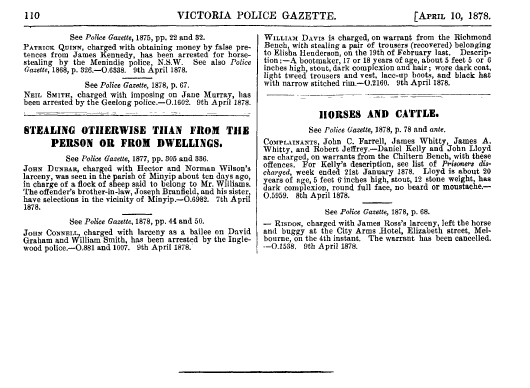
Hi Stuart
Ill start a new thread otherwise the comments get drawn into a long skinny vertical thread thats hard to read. I was ruminating on Michaels latest and thinking about what kind of response it deserved but you got in first with a brilliant response to a very unfocussed post full of sneering and condescension about all sorts of things, not to mention his verballing of you and me. The troll calling himself One who Knows was predictably impressed!
What I couldnt figure out was why he thinks his allegations about various members of Fitzpatricks family are relevant. He seemed to be asserting guilt by association. The fact is we have no idea why Fitzpatrick was sacked as Mayes was never asked to detail the specifics of the infringement that led him to recommend his dismissal and when Fitzpatrick asked for an explanation police closed ranks against him and denied him the open enquiry he sought. His claim that I made ‘extraordinary attacks on Mayes and Mayes descendants’ is bullshit. Questioning Mayes treatment of Fitzpatrick was absolutely legitimate, especially in view of the fact those two petitions were direct contradictions to Mayes claims about Fitzpatricks fitness for office.
Equally, his recitation of Irish history and the Egans was barely relevant, because he claims but doesnt demonstrate an actual direct link between all that and Ned Kellys criminal lifestyle, though he uses it to try to justify it.
Kellys very non-specific references to Irish problems are just non-specific recitations of common-or-garden grievances that any Irish sympathiser author of a Letter to the Editor in the local newspaper could call on.
Having said all that, Michael does at least agree with us on the main subject of this entire Post, that the Kelly Republic was never a thing, and he also agrees with us that Kelly wasn’t a hero or a victim of police persecution….mad beliefs which I think ‘One who Knows’ would hold dear….
(And BTW I am impressed moves were being made to stop the exploitation of Polynesians as far back as the late 19th century)
Hi David, it reminded me of all the people who carry on about Fitzpatrick doing gaol 14 years after the outbreak for cashing false cheques. I’ve never said he was an infallible saint, but it has no relevance to the April 1878 attempted arrest of Dan Kelly on a gazetted warrant. As his Record of Conduct and Service records some 5 months after the Fitzpatrick incident he was still regarded favourably as a promising officer, so all the nonsense about his character is absolutely just nonsense. It was after he was posted to Sydney the following year that things went pear shaped. And in the meantime he was deployed in the North East on the Kelly hunt for several months as shown in the muster rolls, but I have not found any information about him or anyone else in the muster rolls in that time. It’s just a list of which police were in each district month by month. We can reasonably assume he continued to perform his expected duties as there are no indications to the contrary.