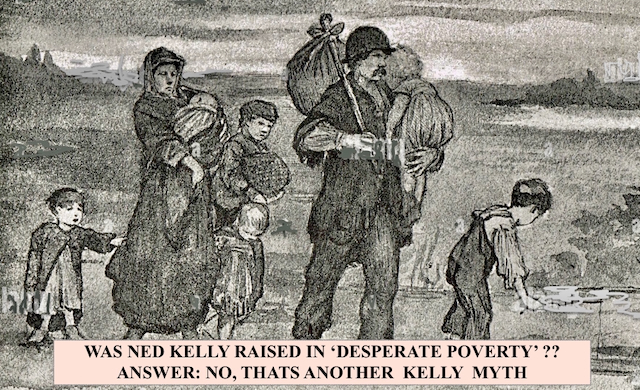
On ‘The Life and Times of Ned Kelly’ FB page the other day, Peterson wrote that Ned Kelly was ‘raised in desperate poverty’. According to AI, desperate poverty is “the most severe and life-threatening form of extreme poverty, characterized by a complete absence of basic human needs such as food, safe drinking water, sanitation, and shelter. It is a state where individuals live in constant crisis mode, often forced to make drastic or illegal decisions just to survive another.” Most Kelly fans would probably now be saying “yes, that sounds about right”
This claim about ‘desperate poverty’ is routinely included in stories about Ned Kelly, and makes him and his family sympathetic figures from the start. The popular image of the young Kelly family is one of an honest everyday struggle just to find food, clothing and shelter, whilst being harassed and victimised by greedy land owners and the police. As far as I know, this feature of the Kelly story has never been challenged. However , just the other day I read something in Ian Jones “A Short Life” that made me wonder if the claim about Ned Kelly being raised in ‘desperate poverty’ is actually true.
You’re probably instantly wondering why I am asking this question when everyone knows what Supt. Nicolson said after he visited them at Greta : “…they all appeared to be living in poverty and squalor”. Doesn’t that settle the question?
Well, no it doesn’t because that was in 1877, and Ned Kelly was grown up by then.
In fact, Kelly reported in the Jerilderie Letter that at that time, when his mother and siblings were found to be living in ‘poverty and squalor’ he was living the life of a ‘rambling gambler’ – which is to say, he was living the high life on the big money he was making from selling stolen horses all over the state. He was said to be fond of his custom-made boots, and as the descriptions of what he was wearing at SBC reveal, he dressed very well, down to the adornment of a red coloured sash. (As an aside, this confession by Kelly completely undermines the Kelly fanatics claim, also repeated by Peterson the other day, that Ned Kelly was “fiercely protective and loyal to his family”! This confession shows him to be much more interested in his own appearance than in trying to alleviate the poverty and squalor his mother and his younger siblings were putting up with back in Greta. Such is narcissism!)
The thing that caught my eye in Jones the other day was this: “John, nicknamed Red for his carroty hair had done well as a gold digger and horse dealer – well enough to pay £615 for a 41-acre farm…overlooking the tiny settlement of Beveridge”. That was 1853, a year in which a labourer would be very lucky to earn £150 in a year. Presumably Red then had to buy animals and equipment – but believe it or not he still had plenty of money left because Jones then writes “ …later in the year he bought a half acre town block and built a house to rent”. The following year, when Ned Kelly was born, it most definitely wasn’t into desperate poverty – his father was the outright owner of a farm and a tenanted investment property! Yes, the Kellys were not selectors but landowners!
Jones then reported that fifteen months after buying the farm, Red Kelly was in debt and he mortgaged the property for £200, and then in 1858, when Ned Kelly was four, he sold it and half the town block, and on the remaining half built what Jones called ‘a shack’, a new home for the family, which I think must be the cottage that still stands in Beveridge today.
Jones also wrote that in 1858 “..Red prospered and was able to buy another ¼ acre block” and in February 1859 “ …Red steadily made his way and in February he was able to afford £70 for 212 acres at the southern corner of town, with a couple of town blocks thrown in”.
Jones writes “….in this period…. the Kelly family had at last achieved some security and stability”. Red now owned a small farm, the cottage in Beveridge and two sections in town: quite a significant property portfolio! In 1863 Ned and sisters Annie and Maggie attended the newly opened Catholic school in Beveridge, but in 1864 Red sold up for £80 and moved to rented land in Avenel, where Ned continued his schooling.
Nothing about his family’s journey to that point suggests anything like ‘desperate poverty’. It’s impossible to imagine that if there was money for the buying and selling of land and animals and equipment, and for building houses including one for rent, that the family went without at least the basic comforts of life, such as adequate housing, food, and clothing. This could not by any stretch of the imagination be called ‘desperate poverty’.
Sadly though for Red Kelly, his farms failed, most probably because of his drinking, and the family fell into debt in the last year or two of his life. There was a drought in 1865, and tragically for the Kelly family, Red Kelly died at the end of 1866, when Ned Kelly was 12. Jones says that the following year Ellen sold up, loaded everything onto a dray, and with cow in tow, journeyed to Greta. Even when they moved to Greta , and Ned Kelly was 13, the Kellys still owned a dray full of personal possessions, a horse and a cow, they had food and clothing and shelter : they went to live with relations in a large delicensed pub.
They were poor but the desperate poverty was yet to come. By then, Ned Kellys childhood was behind him. The claim he had been raised in desperate poverty is a myth.
Hi David, against the widely held belief also found in Jones that Ned and his two sisters Annie and Maggie attended the Avenel Common School after the Kellys moved to Avenel from Beveridge, Annie never did any school after the little she had in Beveridge. She did not attend school in Avenel . She was the oldest sister, and stayed home and helped around the house or land or whatever.
In any case, Ned and Maggie never attended the Avenel Common School, unlike the modern school there continues to claim. The school they attended was the old original Richardson school in Avenel, about half a mile away, on the same side of the main road as Shelton’s hotel. See the attachment, which involved several exciting trips to PROV to research. Avenel Common School opened the year after the two Kelly children dropped out of primary education. Possibly the family could not afford the Richardson school’s fees. It sounds like it all turned to poop after they left Beveridge?
Attachment Avenel-Dawson-Revised-Final-2.pdf
Good points David. All rather overlooked. But what about this folk classic? https://www.youtube.com/watch?v=GYasRDHR0Rw
Hi Thomas, they were wackers, weren’t they! I prefer this one by the Wallabies:
Ned Kelly was born in a ramshackle hut,
A grog house up Beveridge way
He grew up with duffers and bad men and thieves
And those were his lessons all day.
Ned Kelly would ride from the back-country hills,
He’d crawl around town like a sneak,
He’d steal all the poor farmers’ horses, and then
He’d deny everything to the beak.
At sixteen young Ned was a mean vicious lad,
He tried to ride down a hawker
But he was arrested, remanded, and then,
They put him in gaol as they oughter.
When he came out, he was bitter and hard,
Far worse than he ever had been,
As thick as a post, he never did learn
That it’s best to be honest and free.
He shot at Fitzpatrick then blamed the police
Who were looking for Dan on that day
They left their mother to deal with the shit
While they ran like cowards away.
He shot down the troopers who came on his track,
And laughed at the price on his head,
He well deserved to be shot on the spot,
With never a tear to be shed.
Down at Glenrowan they held up the pub,
They were trying to derail a train,
But thanks to the guts of a truly brave man,
The Kellys they waited in vain.
They put on their armour the four little curs,
Then hid behind prisoners in fright.
When Steele threatened after to blow Ned to hell,
He begged for his miserable life.
They took him to Melbourne, and nursed him to health,
The Judge said, ‘You’re guilty!’ to Ned,
A rope from a rafter, the sun in the east,
And the swinish Ned Kelly was dead.
So listen now children whenever you hear
The Kellys were heroes and brave,
It’s only the lies that came out of his mouth
When he had a gun there to wave.