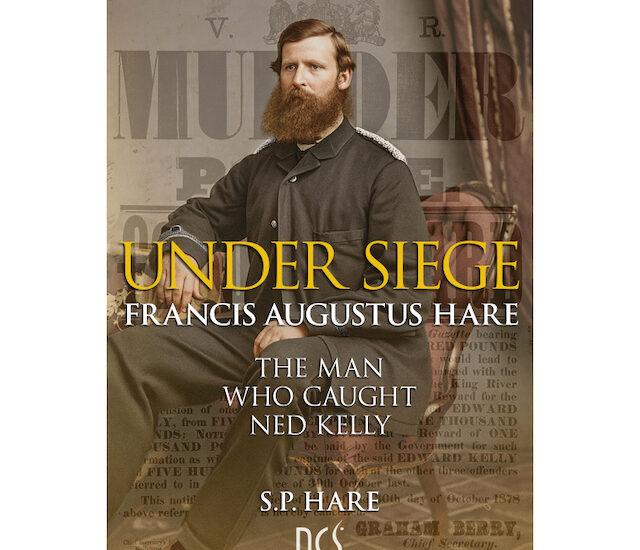
‘Under Siege’ the newly published book about Francis Augustus Hare is sub-titled ‘The Man Who Caught Ned Kelly’. The author is his great-great grand niece Sue Hare.
Sue has written in the first person so that the book reads like an autobiography, giving voice to a man who played a key role in the capture of the Kelly Gang, but who history has not treated kindly. Given that this is Hare himself talking, it is not surprising that he presents himself in a positive light.
Hare starts his story (let’s assume this is an autobiography) by acknowledging the siege at Glenrowan as having been the pivotal point in his life. Indeed, had it not been for his role in the Kelly hunt and the siege, he would have been largely forgotten to all but his family.
As with everyone, there is more to a life than a pivotal event. Sue has put on her genealogical cap and filled in the gaps in Hare’s life by telling us (through his voice) of his formative years spent in Cape Town and his early life in Australia before he joined the police force.
Hare was the 14th of 16 children in a family which I would describe as being typical of the English gentility. His father had been a British army officer who sold his commission and married into an influential and well-off second-generation British family in Cape Town.
Hare had wanted to follow in the footsteps of some of his siblings by joining the British East India Company, but his application was rejected. We learn later in the book that Hare believes his parents may have had a hand in this due to an awareness of proclivities which in those days were something to be ashamed of.
So, instead of going to India, Hare went to stay with one of his brothers who ran a sheep farm in the interior before a hunger for adventure saw him try his luck in Australia. He would have been only 22 years of age when he arrived in Melbourne in 1852. The lure of gold eventually took him to the Bendigo and Ovens goldfields where he had some success – at Read’s Creek his share of the proceeds of one claim amounted to £800, which was an enormous sum back in those days.
Hare had an early brush with fame in 1854 when he single-handedly apprehended a man named Meakin who was attempting to commit a robbery at Dr. Mackay’s station on the Ovens River. Another brush with fame occurred in 1870 when Hare and his rival Nicolson captured the bushranger Harry Power, an incident which saw both men try to claim the credit.
Hare was very familiar with the North East as a result of his early mining and police work, and contrary to what is generally believed he was very comfortable in the bush. He was a physically imposing man and not one to back away from a fight.
The Kelly years were the high point of Hare’s career, and it is interesting to read his take on those years. We know already of course that Hare’s methodology was to actively pursue the gang after every reported sighting, whereas Nicolson placed more value on collecting information though a network of spies and agents. In this book, Hare acknowledges the differences and makes a strong case for himself.
Following the destruction of the Kelly Gang, the Royal Commission into the Police Force of Victoria made findings which were scathing of police command. Police Commissioner Standish, Assistant Commissioner Nicolson and Superintendent Hare all came out of it badly. Hare’s position of course is that he was treated unfairly, not just by the Royal Commission but also the press of the day. Whether this is Sue’s position or not (and I think it is), the fact that she has written this book in the first person means we are seeing things as Hare himself would have seen it all.
The years after Glenrowan make up Part Three of the book. His police career cut short, Hare spent a lot of time at the country estate of his nephew William Clarke, and in pursuing his interest in sports such as cricket and horse racing. For more than a decade, he worked as Police Magistrate, which he took to with ease and which allowed him to enjoy ‘Marvellous Melbourne”.
In this book, Sue has not shied away from Hare’s sexuality. She has Hare from his early days suspecting that others knew of his ‘sinful’ thoughts, and has him more or less acknowledge his marriage in 1867 to Janet Snodgrass (who Sue has fictitiously nicknamed ‘Nettie’ as a means of differentiating her from Janet the wife of Hare’s friend William Clarke) as being a marriage of convenience for both of them.
Hare died in 1892 from diabetes at the age of only 62 years, by which time he had been retired for over a decade. This reinforces to me how young many of the people involved in the Kelly saga had been. The man James Wallace, who I had written my own book about, was only 56 years old when he died (also from diabetes) in 1910 – he was only 26 years old at the time of the Glenrowan siege. Likewise, the Kelly Gang members were very young men at the time – Ned and Joe were about the same age as Wallace, while Dan and Steve were not even 20 years old.
Hare left an estate of some £4741 which surprisingly included no property. Most of his worth comprised what I guess could loosely be called ‘bling’ .
Sue has a chapter at the end of the book titled “Heroes of Latter Days” where she talks of how she became aware of her ancestor and spent years researching records at the SLV and PROV and on sites like Ancestry.com. I know from my own experience in researching James Wallace and my own family history what an arduous journey that can be. When I bought a copy of her book from her at Glenrowan, Sue told me she had spent 12 years doing her research. I can relate to that, having spent about 8 years on Wallace. Filling in the gaps becomes an obsession. You collect so much information and then it is a case, as Sue says, of deciding what to include and what to exclude. Including every bit of minutia is tempting, but doesn’t make for easy reading. Sue is an accomplished writer and has managed to edit it all down so it is all very readable.
Sue acknowledges the criticisms directed towards her great-great-granduncle both in his day and subsequently, but “started to feel Hare had been a little hard done by (by) some of those who took ownership of the Kelly narrative, as well as (by) certain members of the police force”. In her view, “the constant criticism and denigration of Hare, which occurred in later publications, did not stack up against the contemporary reports of the man.” In her view, there needed to be a villain and by the mid-twentieth century, writers clearly had the police in their sights.
In this book, Sue has made a strong case for her ancestor. I don’t personally share those views, but it is good to get his side of the story.
“Under Siege” is a very well written biography. Anyone interested in the Kelly story needs to read it.
Hi Peter, thanks for doing this review, I didn’t know about this book. It certainly sounds interesting. Does it add much more content to the Kelly hunt section of Hare’s “The Last of the Bushrangers”, or is it more broadly about his life story? It sounds like a good read regardless, but I’m just curious about the Kelly hunt part, what it adds to that beyond what he wrote back in the 1890s.
Thank you for this review, Peter: as someone who is halfway through this book, I too am appreciating the candid autobiographical style in which Sue has approached it. Supt Hare is obviously a more complex character than many have earlier realised ..
Thank you for this review Peter. I am about halfway through this book ATM, and am enjoying Sue’s autobiographical approach to the story. Supt. Hare was indeed a complex character, who has perhaps escaped the depth of commentary he has deserved over the years …..
Sue’s book puts forward a positive case for Superintendent Hare. It is written in the first person as though it is Hare himself doing the talking, and from that point of view the book is a great contribution to Kelly literature.
However, my personal view is that the Royal Commission into the Police Force of Victoria got it pretty much right in their assessment of the man.
Hare was lucky he had replaced Nicolson only a week out from Glenrowan, otherwise it is likely that Nicolson would have been the one who would have been claiming the credit as the man who caught Ned Kelly (and the majority of the reward money).
The Commission into the Police Force of Victoria criticized Police Commissioner Standish for displaying a lack of impartiality, temper, tact, and judgement in dealing with his subordinates. In its Second Progress Report (para. 3), the Commissioners found that Nicolson had labored under great difficulties due to undue interference by the Chief Commissioner and the jealousy occasioned by his favoritism towards Superintendent Hare.
In para 4 of its report, the Commissioners found that a charge made by Hare that Nicolson had given him no verbal information whatever when he took over from Nicolson at Benalla (immediately prior to Glenrowan) had been disproved by the evidence.
In para. 5, the Commissioners stated that although they considered Hare’s services in the police force to have been praiseworthy and creditable, they found that nothing special had been shown in his actions that would warrant the Commission to recommend his retention in the force, especially when the “strained relations” between he and Nicolson had had such a damaging influence on the effectiveness of the service.
Commissioner Edward Dixon lodged a protest (Protest A) against the majority of the Commission with respect to paras. 3 and 5, and as a consequence did not sign the Second Progress Report. In his view, the evidence did not support the findings as put forward in those paragraphs.
Interestingly, two of the other Commissioners (James Gibb and George Collins Levey) also lodged a protest (Protest B) against paras. 3 and 5, to the extent it partly blamed Nicolson for the want of unanimity existing between him and Hare. They were of the view that this was not borne out by the evidence. Obviously, they felt Hare was to blame, given they supported the motion recommending Nicolson’s superannuation, but did not see anything in the evidence to warrant the recommendation that Mr. Hare should be superannuated.
The four Commissioners who had not protested saw fit to reply in some detail to Mr. Dixon’s protest. In doing so, they expressed the view (para. 24) that they had been compelled “to refer to matters that otherwise had better be buried in oblivion”. In other words, had Commissioner Dixon not protested, the Commissioners would have preferred to have let some of the matters relating to Hare lie “buried in oblivion”. But as these matters had been raised, they felt compelled to address them. The Commissioners response runs to four pages, but some of the important responses they made are as follows:
• In relation to Hare’s conduct in connection with the demoralized state of the colony’s police force, there was every reason to believe that he was throughout in direct collusion with Captain Standish in the petty and dishonorable persecution to which Nicolson was subjected for many years.
• In relation to the personal feuds and jealousies between Hare and Nicolson, “Hare appears to have adroitly sheltered himself behind the late Chief Commissioner”.
• That had there been proper concert between the officers, the Euroa bank robbery might have been averted (the issue here was the withholding of information from Nicolson about the likelihood of a bank robbery).
• That when Nicolson took charge in June 1879, sweeping reductions in manpower were insisted upon. When Nicolson applied for replacements, Hare sent him men who the Commissioners described as useless.
• That Hare let information about Nicolson’s cave party be known among the Depot (thus ensuring word got out).
• That when Nicolson was endeavoring to improve the efficiency of his men by rifle practice, Hare told Standish that the men were simply wasting ammunition.
• That the organisation of the Sherritt hut party was due to Hare and proved to be a disastrous failure.
• That Hare’s conduct at Glenrowan was lacking in judgement and forethought, and that he left the front (after being shot in the hand) without transferring the command.
During the course of the Commission, Hare had lodged his own report responding to some of the evidence that had been heard. In the Commissioner’s reply to Mr. Dixon’s protest, the Commissioners responded as follows (para. 22 of their reply):
22. It is, however, chiefly in relation to Superintendent Hare’s official report of the 2nd of June 1880 that we, the undesigned Commissioners, have been led to regard this officer’s conduct with suspicion. The document was manifestly written with the design of crushing Mr. Nicolson once and for all; to deprive him of all credit for anything that he had done or suffered in the pursuit, and to brand him as disloyal to the service and his brother officers. The evidence, however, discloses that many of the charges contained in the report were unfounded, the insinuations unjustifiable, and the statements mere assumptions.
And in para. 23: “… it is only fair to conclude that Superintendent Hare has been for many years a disturbing element in the force, and that his withdrawal from the service has become a matter of public necessity.”
Again, had Hare not lodged his own report and had Mr. Dixon not protested against his fellow Commissioners report, Hare’s failings would have remained “buried in oblivion” which is what the Commissioners had preferred in deference to his long service with the police force.