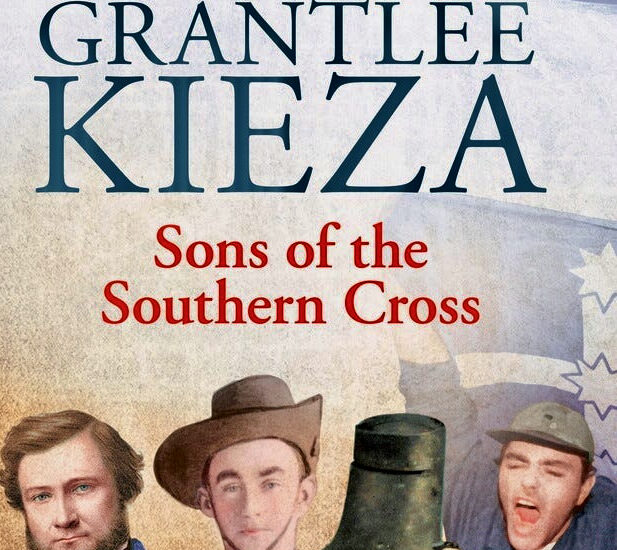
‘Sons of the Southern Cross’ by Grantlee Kieza was published in 2014.The cover features the Eureka Flag and four figures: Peter Lalor, a digger, Ned Kelly in armour and a Trade Unionist. On the back, it says Kieza ‘…. tells the rich and rollicking story of the (Eureka) flag though the tales of the miner’s soldiers shearers bushrangers politicians and reactionaries who fought under it. He brings to life Australia’s renegade history and the men and women behind it.” The Kelly story occupies two full and comprehensively referenced chapters.
I saw this book in the remainders bin at QBD the other day – I hadn’t ever seen or heard of it before but soon realised it was actually the first of three books in which Kieza discusses Ned Kelly in detail. The other two were “Mrs Kelly” in 2017 and “The Kelly Hunters” in 2022.These three books of his emerged at the beginning, in the middle and at the end of a decade in which the core beliefs of the Kelly legend were undergoing critical scrutiny that was long overdue, the opening salvo being Ian MacFarlanes ‘The Kelly Gang Unmasked’ in late 2012. Over the decade that followed, as Kieza was publishing his books about Kelly, MacFarlanes critique was being enlarged by Dr Doug Morrisseys three books, Dr Stuart Dawsons ground-breaking series of papers focussed on key elements of the story, and Leo Kennedys “Black Snake”, which pushed back on the anti-police rhetoric of the standard Kelly narrative.
To me, this new scholarship was convincing….but then, I had skin in the game as an enthusiastic and early supporter of MacFarlane and Dawsons work, and as a Blogger and FB page moderator my colours were nailed to the mast. But Kelly admirers claim to this day that nothing has changed… they claim these writers are just revisionist Kelly haters that nobody takes any notice of.
Kiezas three works provided me with an opportunity to find out if the new critiques and our discussions on the Internet were even being noticed by anyone other than the enthusiasts, but if they were, how they were being received by people like Kieza who didnt have skin in the game. Kieza very visibly and publicly had a burning passion for educating people about Australian history and for telling it honestly and accurately. What I wanted to know was what effect all this writing and thinking had on his understanding of the Kelly story: I wanted to know if the scholarship that I found compelling affected him in the same way. I guessed I would find out by comparing what he wrote in 2014 with what he wrote in 2022.\
Here’s some of what Kieza wrote in 2014 about the Republic of NE Victoria, the idea promoted by Ian Jones for fifty years that was central to almost everyone’s thinking about the Outbreak in 2014:
“Not only does Ned declare war on the Victorian government, but he also appoints himself as General of a small movement of disaffected Irishmen who are toying with the idea of an independent Irish stronghold in north eastern Victoria. He begins penning his own Declaration of Independence….”
Further on he wrote this:
“In the late winter of 1879 he and key supporters headed by his favourite cousin, Tom Lloyd, begin meeting to discuss their own dream of a republic in north-eastern Victoria. Joe Byrne takes notes in a series of notebooks”.
He also had this to say:
“The Kellys circulate handbills of Neds latest proclamation, his Declaration of North Eastern Victoria”.
Clearly, in 2014, Kiezas book promoted as historical reality the main elements of the claim made by Ian Jones in 1967 and thereafter widely accepted, that Kelly became the leader of a selector army that was planning to overthrow the existing administration and to declare the North east of Victoria a Republic. Kieza’s claim was not at all controversial in 2014.
So what did Kieza have to say about the Republic of NE Victoria and the exercise books and the handbills eight eventful years later, in his 2022 book, ‘The Kelly Hunters’? Answer: absolutely nothing! The only “Declaration” mentioned in it was one made by a policeman to the Royal Commission, and to my amazement, the word “Republic” doesn’t appear even once, a quite remarkable turnaround.
Clearly, in dropping all references to a republic, Kieza had done a complete about face in his understanding of what motivated the Kelly Gang. In 2014 he believed it was a Republic, but by 2022 all that high-minded rhetoric was gone, and in its place a narrative about violent criminality, about wreaking vengeance and retribution, about murder and bank robbery:
“While Kelly had tried to fashion a romantic portrait of himself as a victim of police brutality who only killed in self-defence at Stringybark Creek, he now planned rivers of blood in an ambush that would cut down as many of his enemies as he could”
This reality was the one that everyone understood to be the truth in 1880 and for many decades after. It was the reality that people like Jones didn’t want to face, and was the motivation for his creation of the myth of the Republic, a fantasy that Kelly admirers still cling to, the fig leaf that was supposed to conceal the awful truth about how deranged and blood-thirsty Ned Kelly really was.
So, Kieza had switched sides on the crucial issue of the Republic. I was also interested to find out if he had been persuaded by any of the other criticisms of the Kelly legend so decided to compare what he wrote about Fitzpatrick in 2014 and see if that also had changed by 2022.
Here’s some of what he wrote in 2014:
“On the afternoon of Monday April 15th 1878 Alexander Fitzpatrick, a constable on shaky ground with his superiors for his drinking and dishonesty, decides to make a name for himself. Despite official orders that two officers must be present any time police visit the Kelly house Fitzpatrick swaggers up alone ….”
“No one can really be sure what happens next but its likely that Fitzpatrick makes a lewd suggestion to Kate and trues to drag her onto his knee. Ellen threatens him with a fire shovel and Ned disarms him. Fitzpatrick suffers a grazed wrist that may have been the result of scraping a door handle. Fitzpatrick is sent away with a boot in his backside and Dan and Ned Kelly beat a hasty retreat…”
“A doctor who examines Fitzpatrick says he can smell brandy and the wrist injury is merely a skin graze…”
This was a typical recitation of what was then regarded as the truth about Fitzpatrick: he was a womanising drunk, he was a very unsatisfactory policeman who went to the Kelly shanty against orders, he lied about what happened, and the doctor who examined the injury didn’t think it was caused by a bullet as Fitzpatrick was claiming.
The year after this book was published, Dr Stuart Dawson published “Redeeming Fitzpatrick” , a meticulous review of Fitzpatrick’s police career which exposed the Kelly narrative about him to be deeply flawed. Quite clearly because of Dawsons analysis, instead of implying Fitzpatrick was an unreliable womanising drunk, two years later in his 2017 book “Mrs Kelly” Kieza wrote:
“History will not be kind to Fitzpatrick but in April 1878 he is regarded as reliable enough to take temporary charge of a police station in an area that has become a hotbed of crime”
Instead of suggesting Fitzpatrick disobeyed orders when he went to the Kellys, Kieza now writes this: “Superintendent Nicholson may have warned other policemen not to approach Ellens hut without backup but Fitzpatrick hasn’t received that directive. Whelan is all for having him collar the suspect but tells him ‘be careful Alex’”
This time instead of suggesting Fitzpatrick’s wound was ‘merely a skin graze’ Kieza quotes Dr Nicholson’s opinion that it had “all the appearance’ of a bullet wound.
Kieza provides a lot of detail about what was supposed to have happened when Fitzpatrick visited the Kelly hut that day in 1878, but makes one thing very clear : Fitzpatrick gave a consistent and believable account of what happened, but by giving so many inconsistent and conflicting accounts from day one, the credibility of the Kelly mobs accounts were completely ruined.
My review of Kiezas Kelly writing over a decade revealed a truly heartening, reassuring and quite marked transformation in his thinking and writing. It was an affirmation we are on the right track and that the Kelly fanatics who think nothing has happened in the last fifteen years have missed the boat. They’ve been left behind clinging to and arguing for versions of Outbreak history that have been tossed out.
Congratulations to Grantlee Kieza for being willing and able to look again at the Kelly legend and change your mind when the facts demanded it.